GeoSpoof vs Spoof Geolocation: A Signal-by-Signal Comparison
Spoof Geolocation and GeoSpoof both change your browser's reported location, but on a full fingerprint test GeoSpoof keeps every signal consistent while Spoof Geolocation only moves the map pin. In our runs it set the geolocation correctly but left your real timezone untouched, so it failed every zone-specific timezone check, returned your real local values from getDate, getDay, getHours, and getTimezoneOffset, got every Date string wrong except the absolute UTC one, failed all Intl formatting, and failed every advanced worker surface. GeoSpoof passed all of them.
Changing the location a website sees is the easy part. Any extension can set
navigator.geolocation to coordinates in Tokyo. The hard part is making every
other signal agree, because a site that catches one disagreement doesn't see
Tokyo — it sees someone pretending to be in Tokyo, which is worse than not
hiding at all.
So instead of comparing feature lists, we put Spoof Geolocation and GeoSpoof through the same test: our own browser location test page, which probes the full stack of signals a real fingerprinting script would check. Same browser, same target location, same checks. Every screenshot below is a live result.
Spoof Geolocation is the natural benchmark here: with over 100,000 users on the Chrome Web Store, it's the most widely used location spoofer on both Chrome and Firefox. If you've searched for a way to change your browser's location, it's probably the first extension you found — which is exactly why it's worth holding to a full fingerprint test rather than taking "it moves the map pin" at face value.
How the test works
The verify page doesn't just read back the location you set. It pulls
each signal independently — the timezone offset, individual Date methods,
locale formatting, and a set of exotic execution contexts — then checks whether
they tell the same story. A green result means the signals are internally
consistent. A red one means a site could spot the contradiction.
If you want to follow along, install either extension, set a location, and open the test yourself. Nothing here is hand-picked; it's just what the page returns.
The setup
Both extensions are pointed at the same target location through their own popup, so we're comparing like for like.
GeoSpoof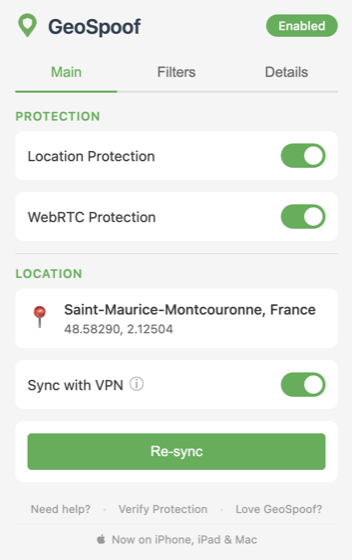 Spoof Geolocation
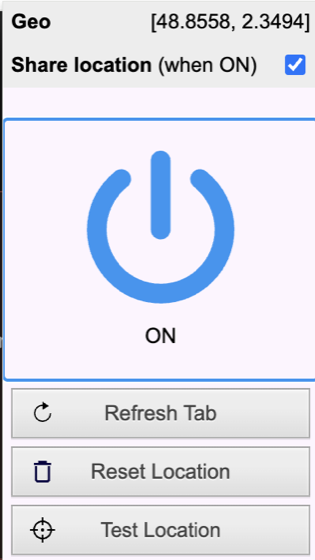 Both extensions set to the same reference location before the test.
1. The overview
First, the top-level verdict with each extension active and spoofing to the same location.
GeoSpoof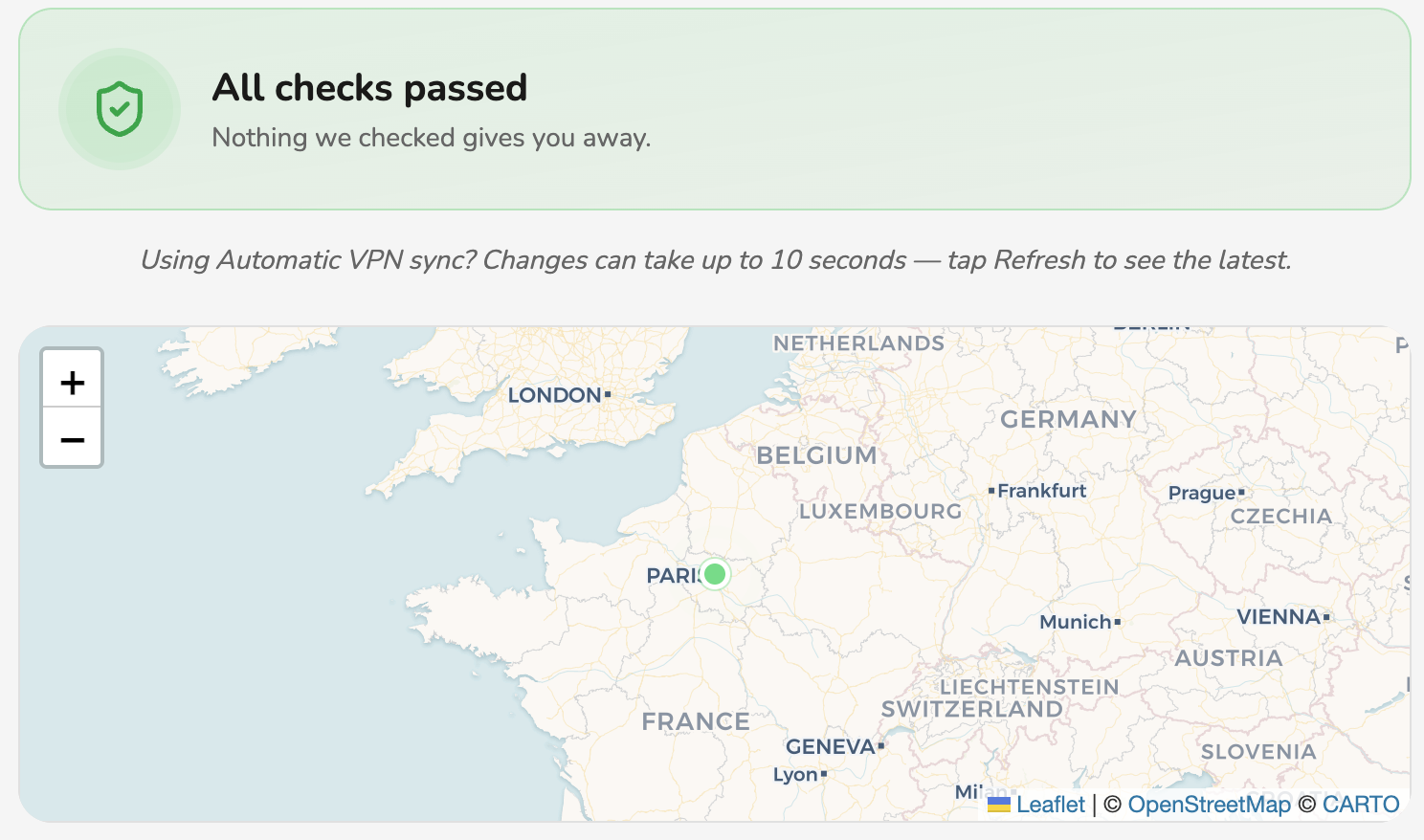 Spoof Geolocation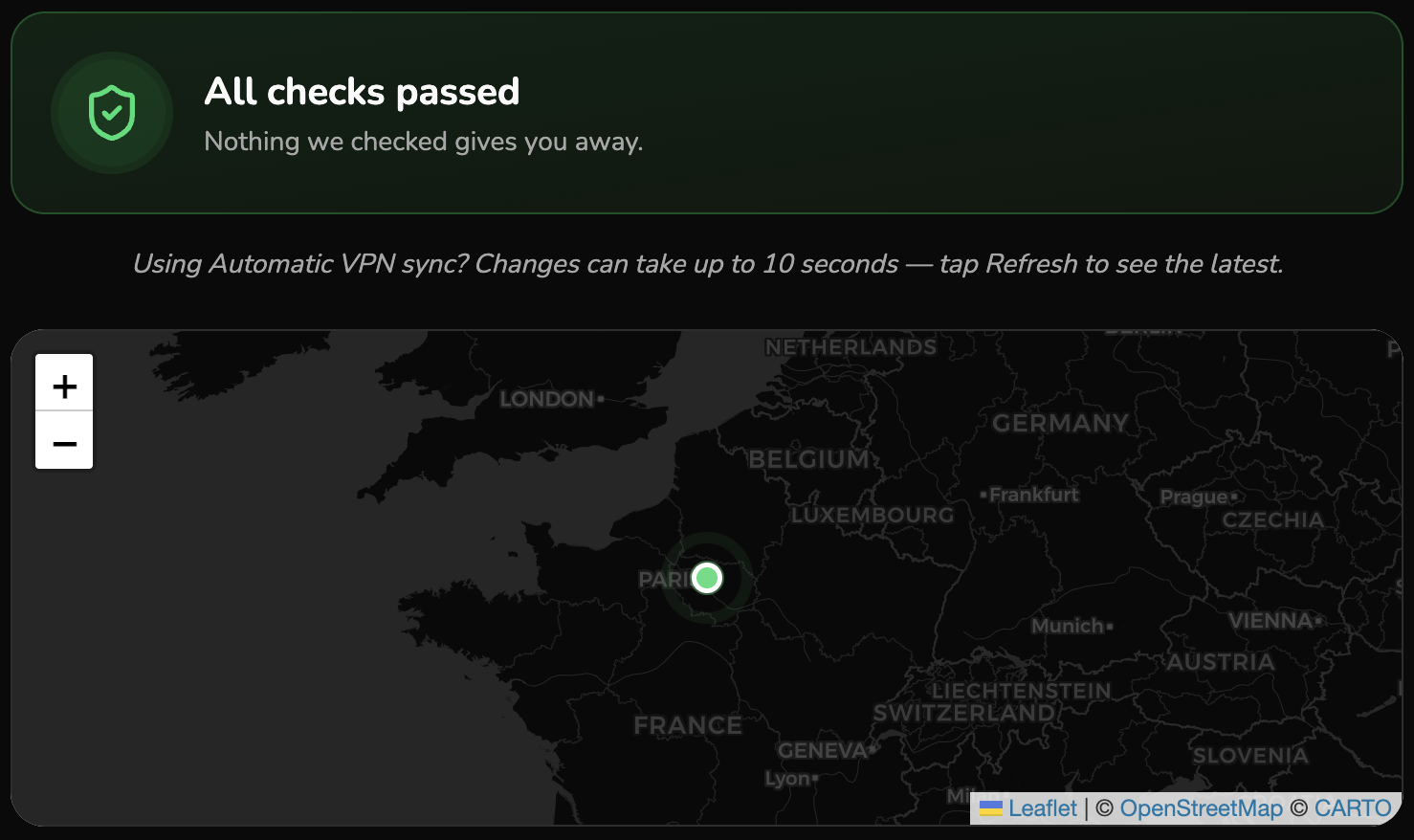
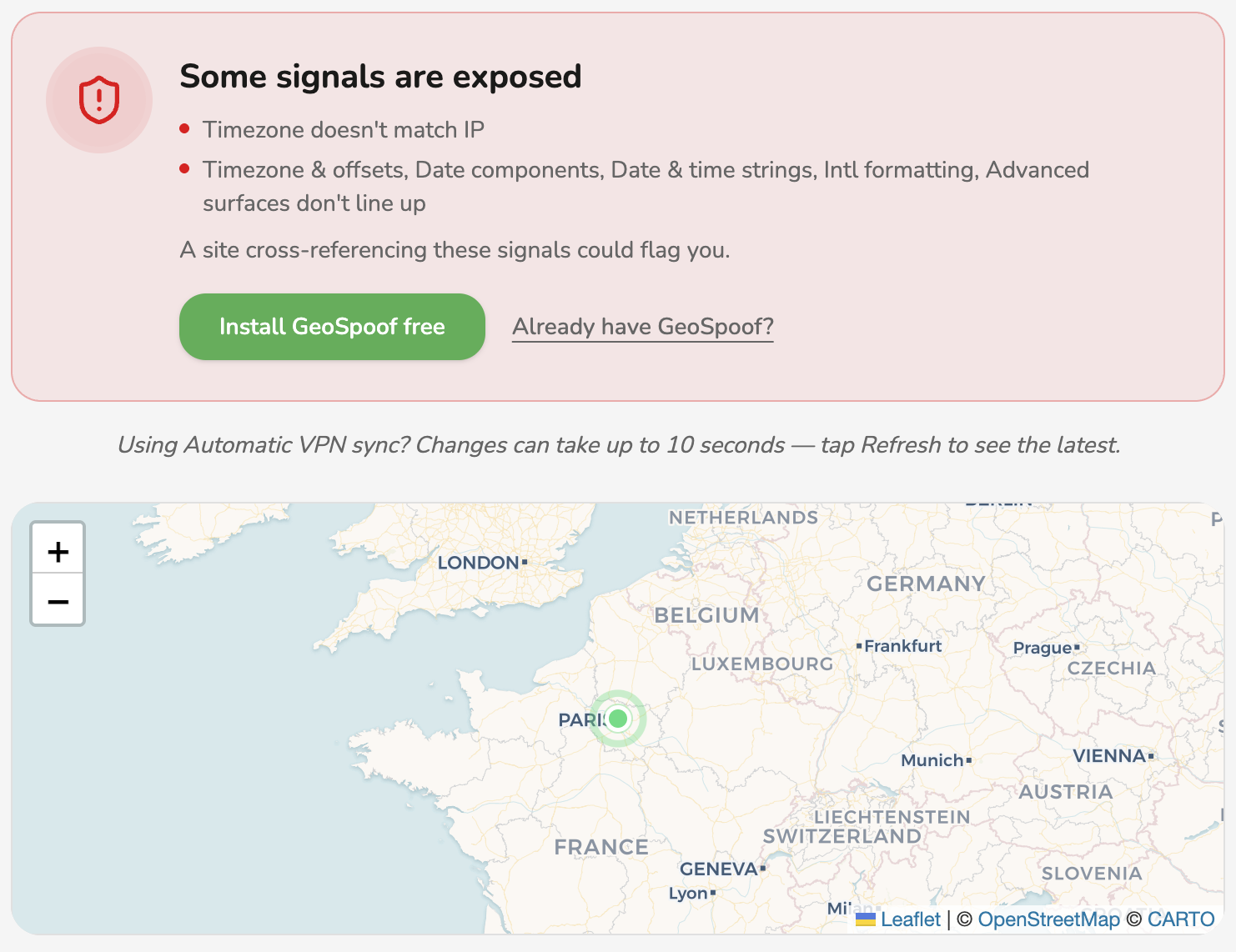 GeoSpoof comes back clean; Spoof Geolocation leaves several signals exposed.
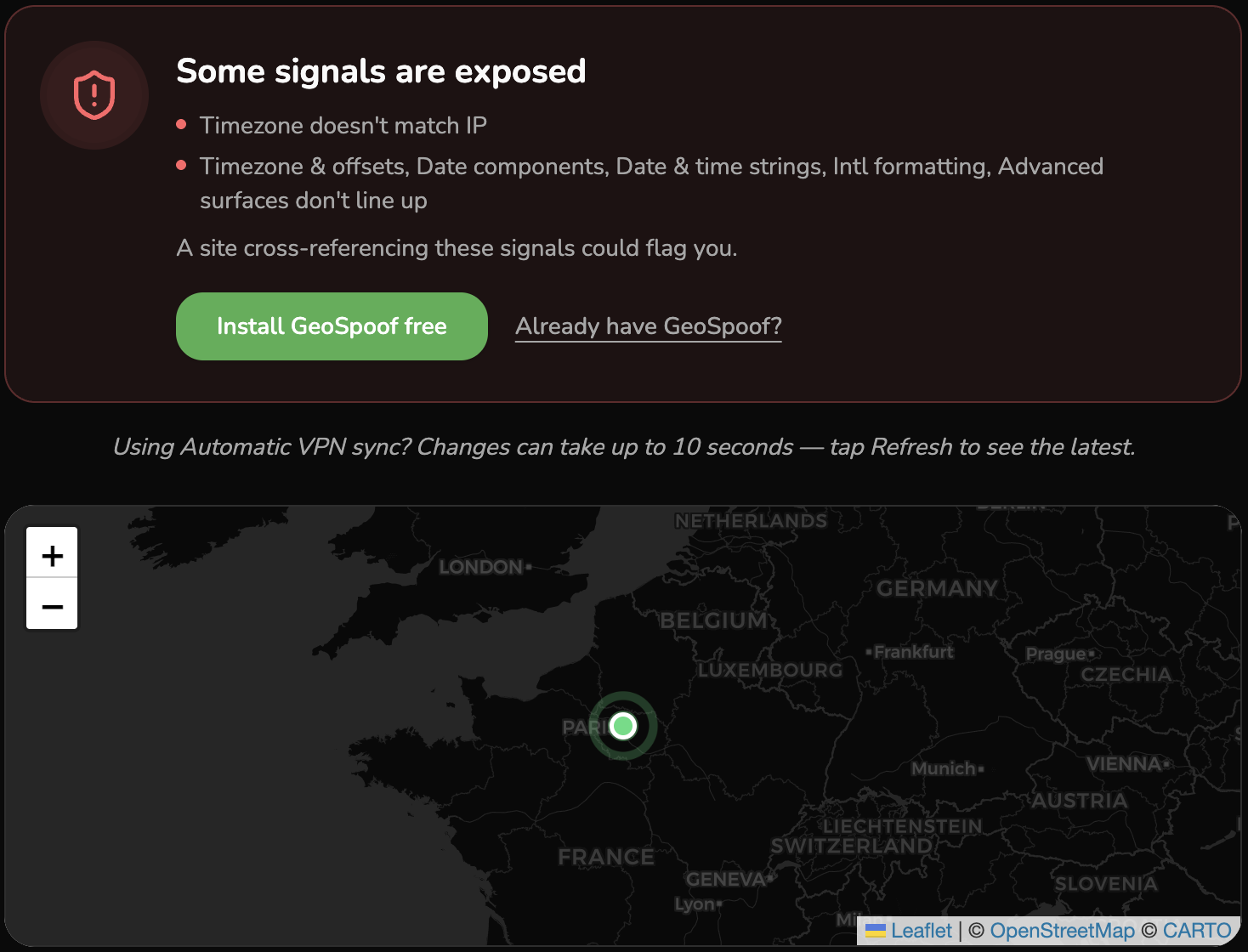
Spoof Geolocation moves the location, but the summary flags exposed signals
across the timezone offsets, the Date components, the date and time strings,
Intl formatting, and the advanced surfaces. GeoSpoof reports a clean, consistent
result. The rest of the post is just walking through why — one signal at a
time.
2. The primary results
A closer look at the main signals the page reads first.
GeoSpoof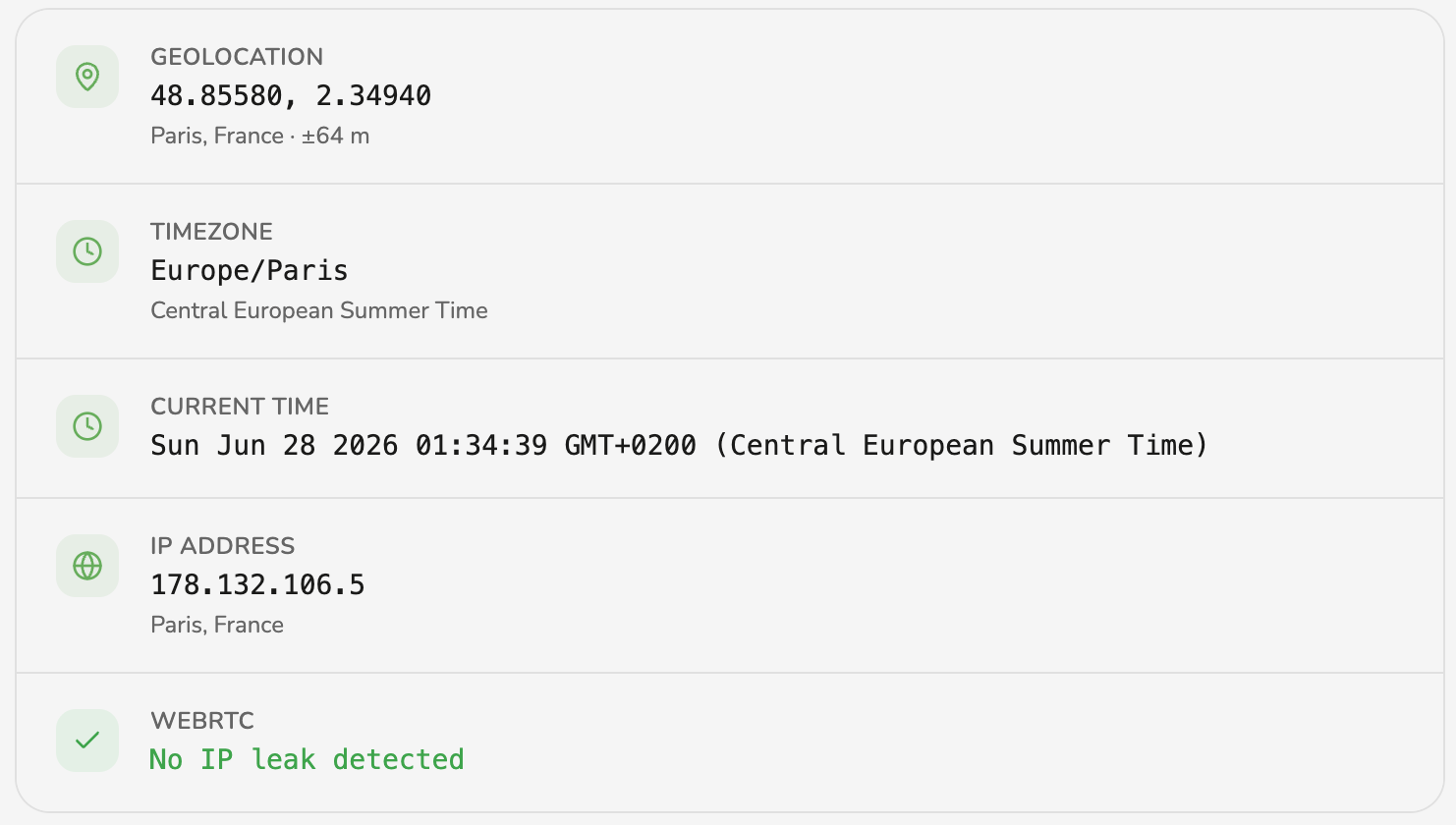 Spoof Geolocation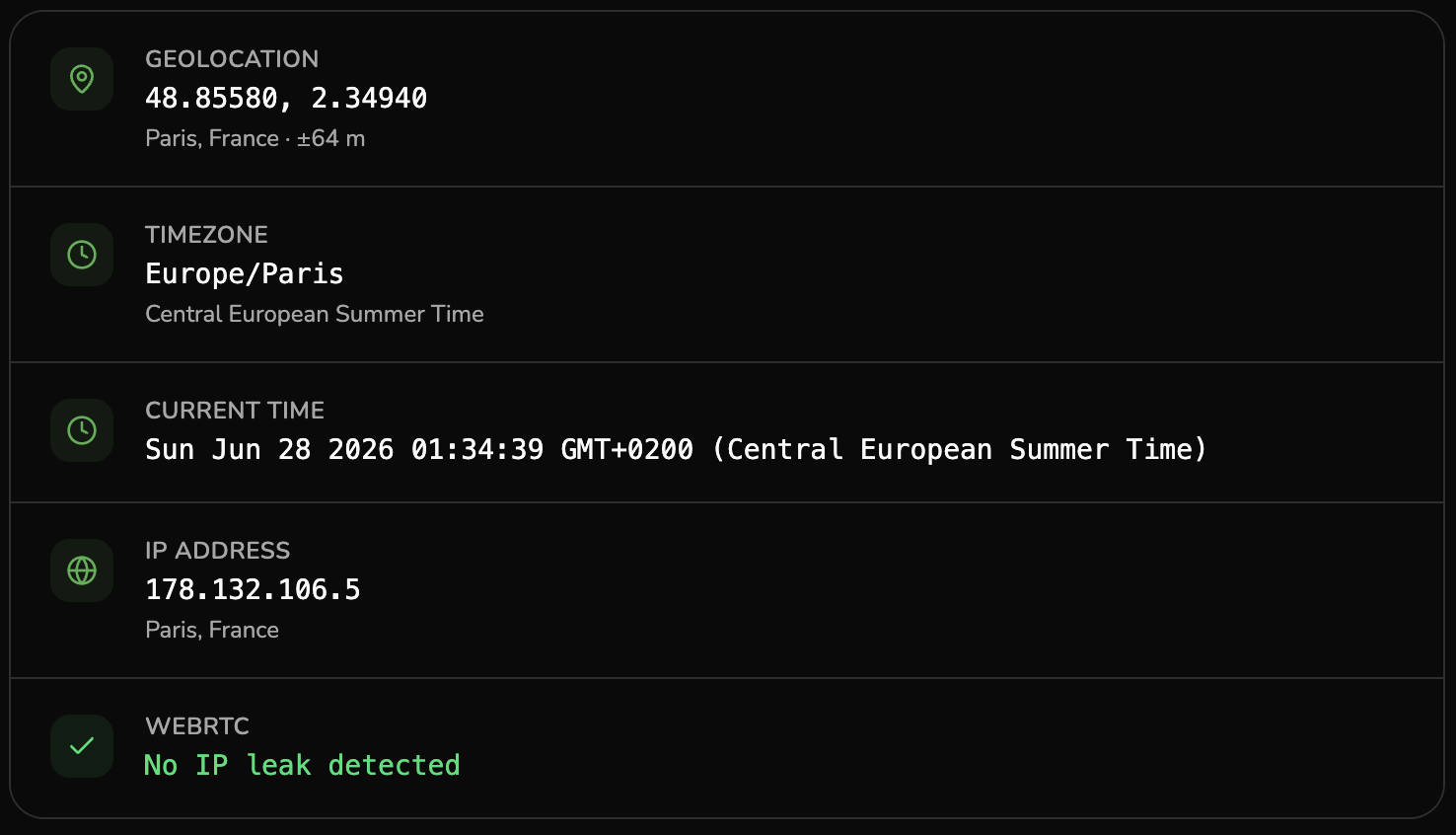
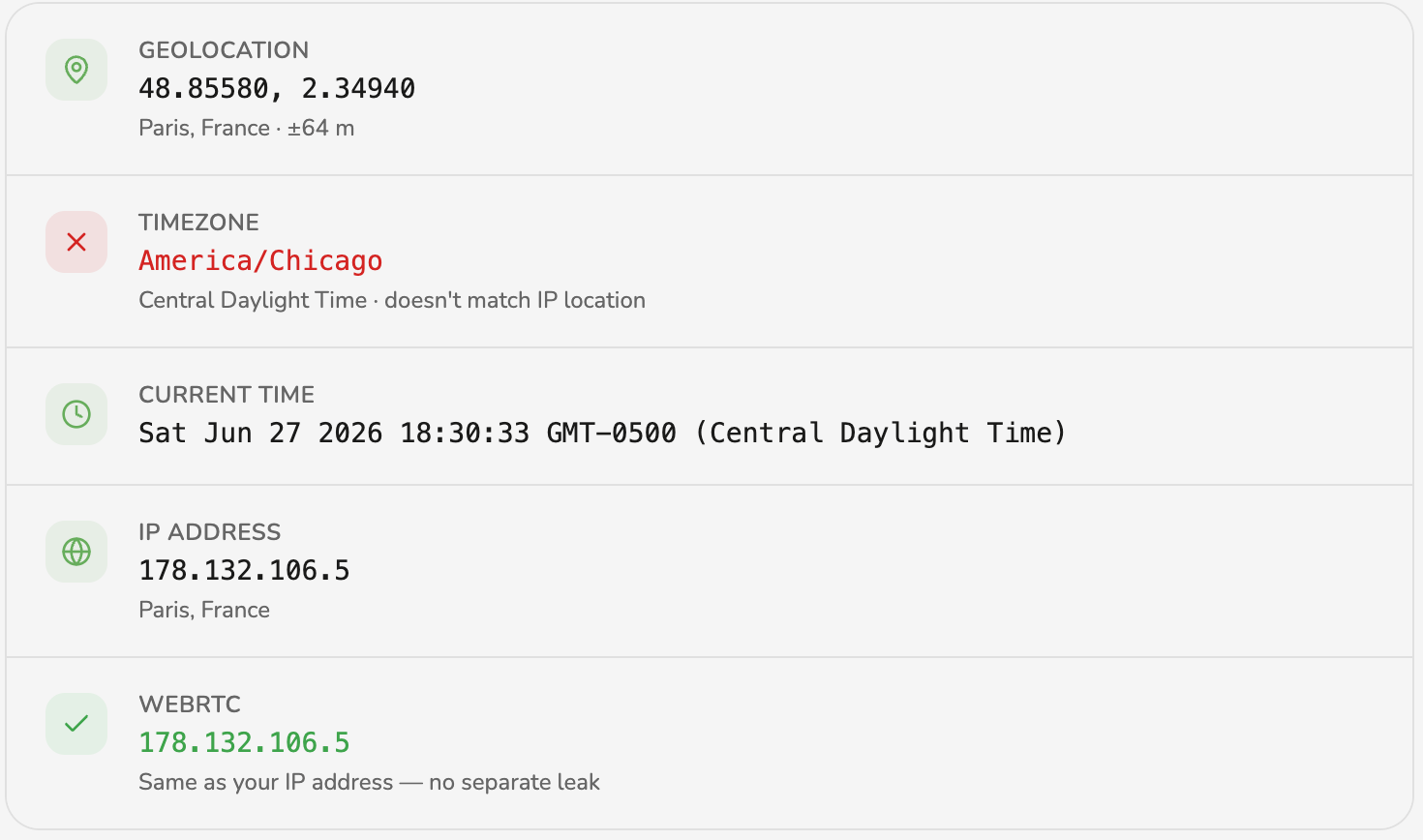 The same target location, but only GeoSpoof keeps the supporting signals in line with it.
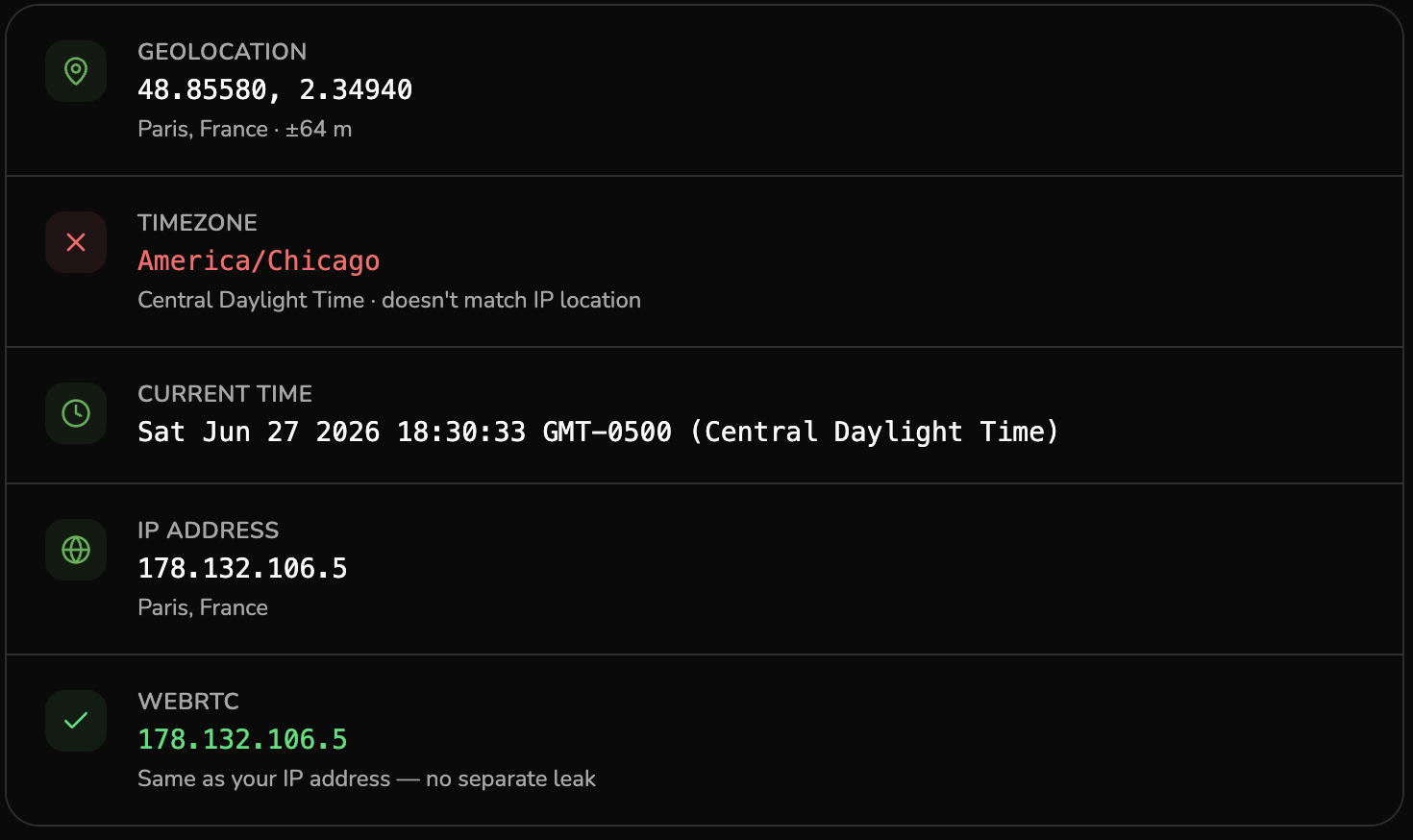
The pattern that runs through the whole comparison is already visible here: Spoof Geolocation gets the coordinates right and then leaves your real timezone in place for everything that involves time. So those signals don't just disagree with the pin — they keep pointing at where you actually are. GeoSpoof shifts the clock to match the spoofed location, so the supporting signals follow the pin.
3. Geolocation
The geolocation API itself — the actual coordinates behind the map pin. This is the one signal both extensions are built to handle, and our target location is the reference point everything else is measured against.
GeoSpoof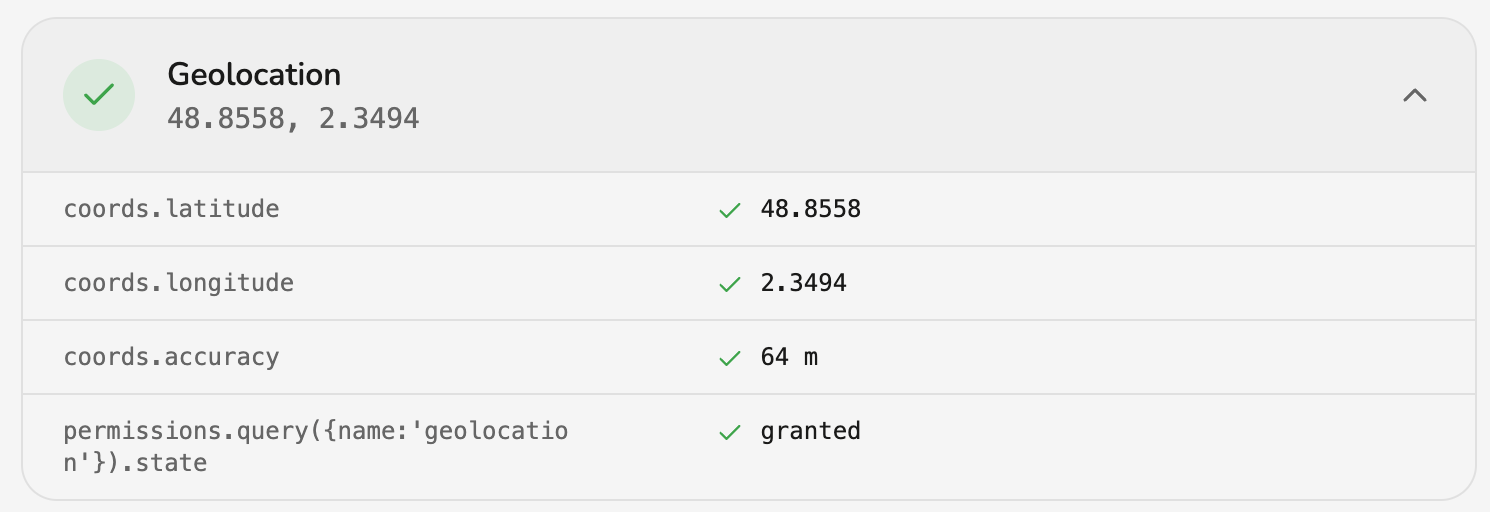 Spoof Geolocation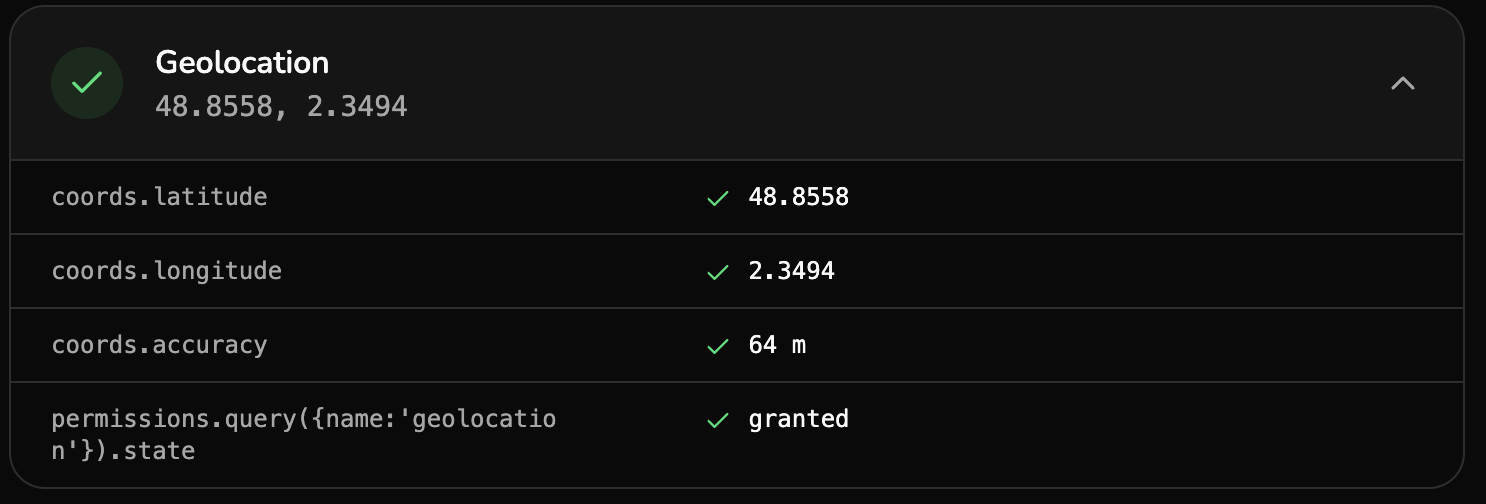
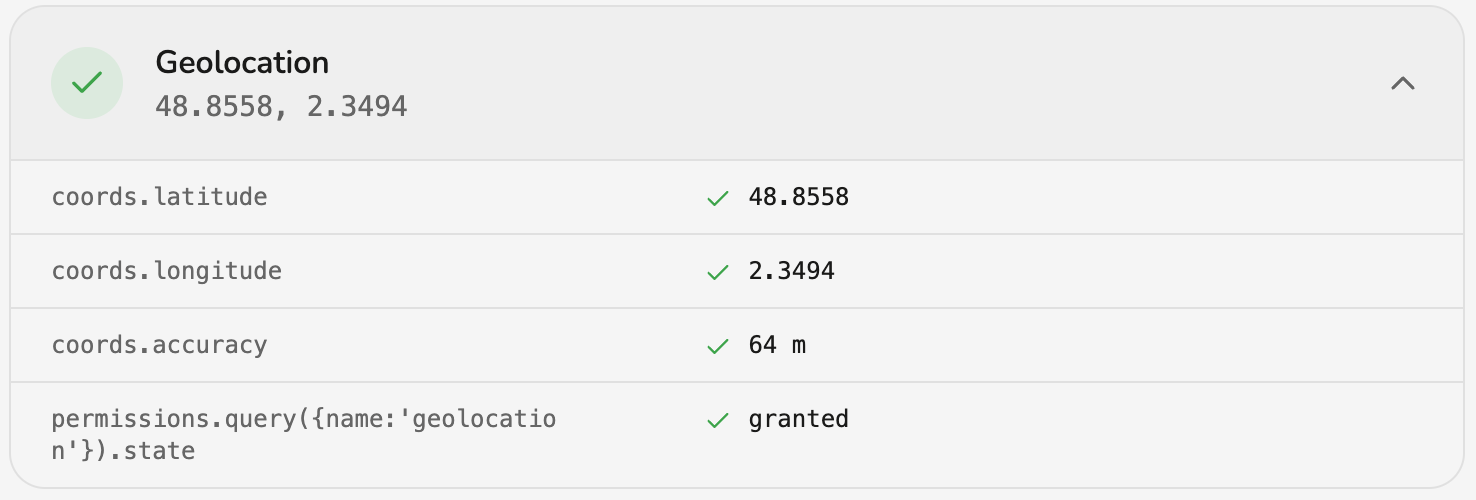 Both extensions set the coordinates correctly — this is the easy part.
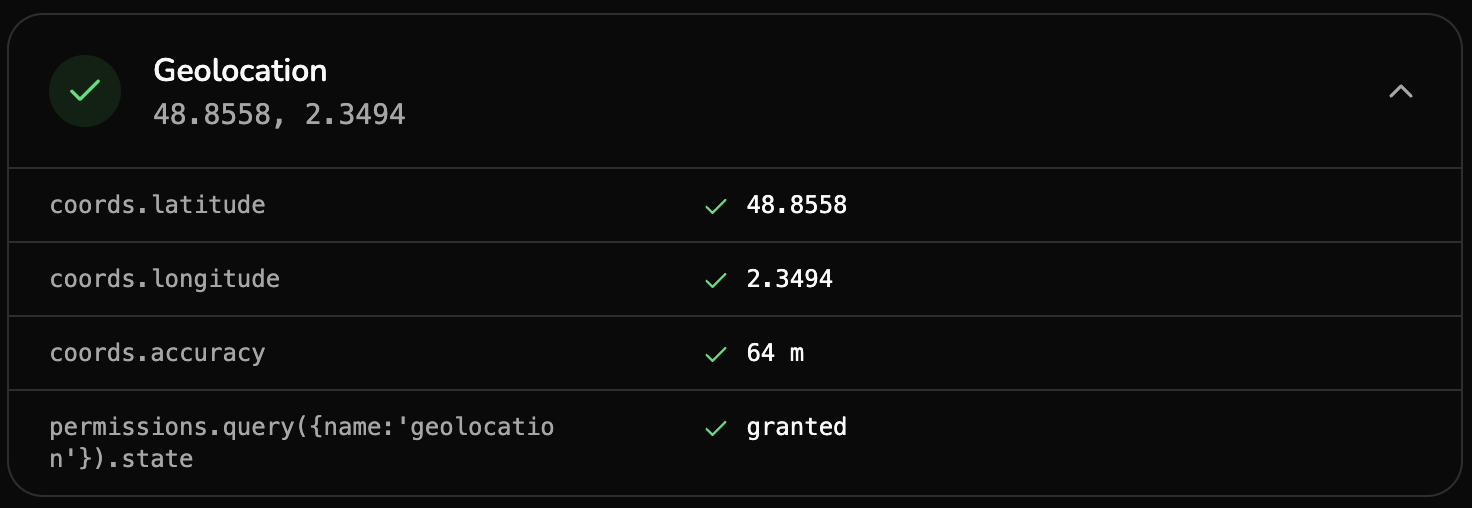
Both pass. Spoof Geolocation places the pin exactly where it should be, same as GeoSpoof. If moving the map pin were the whole job, the comparison would end here. It isn't — every section below checks a signal that has to agree with this pin, and that's where the two extensions split.
4. Timezone and offsets
A spoofed location is only believable if the timezone matches it. The reported UTC offset has to line up with where the pin sits, and it has to be right for any date, since daylight-saving rules have changed over the years.
GeoSpoof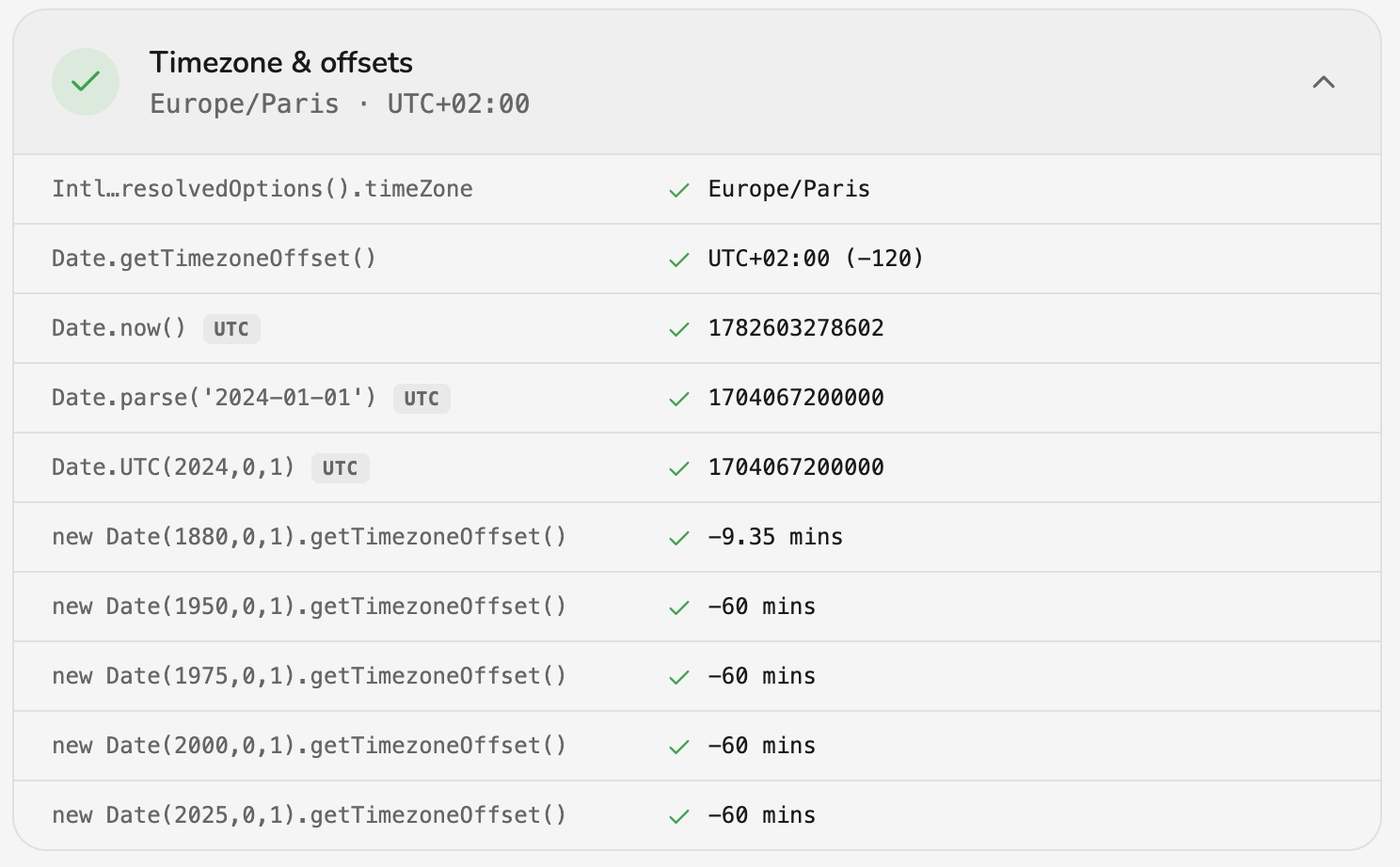 Spoof Geolocation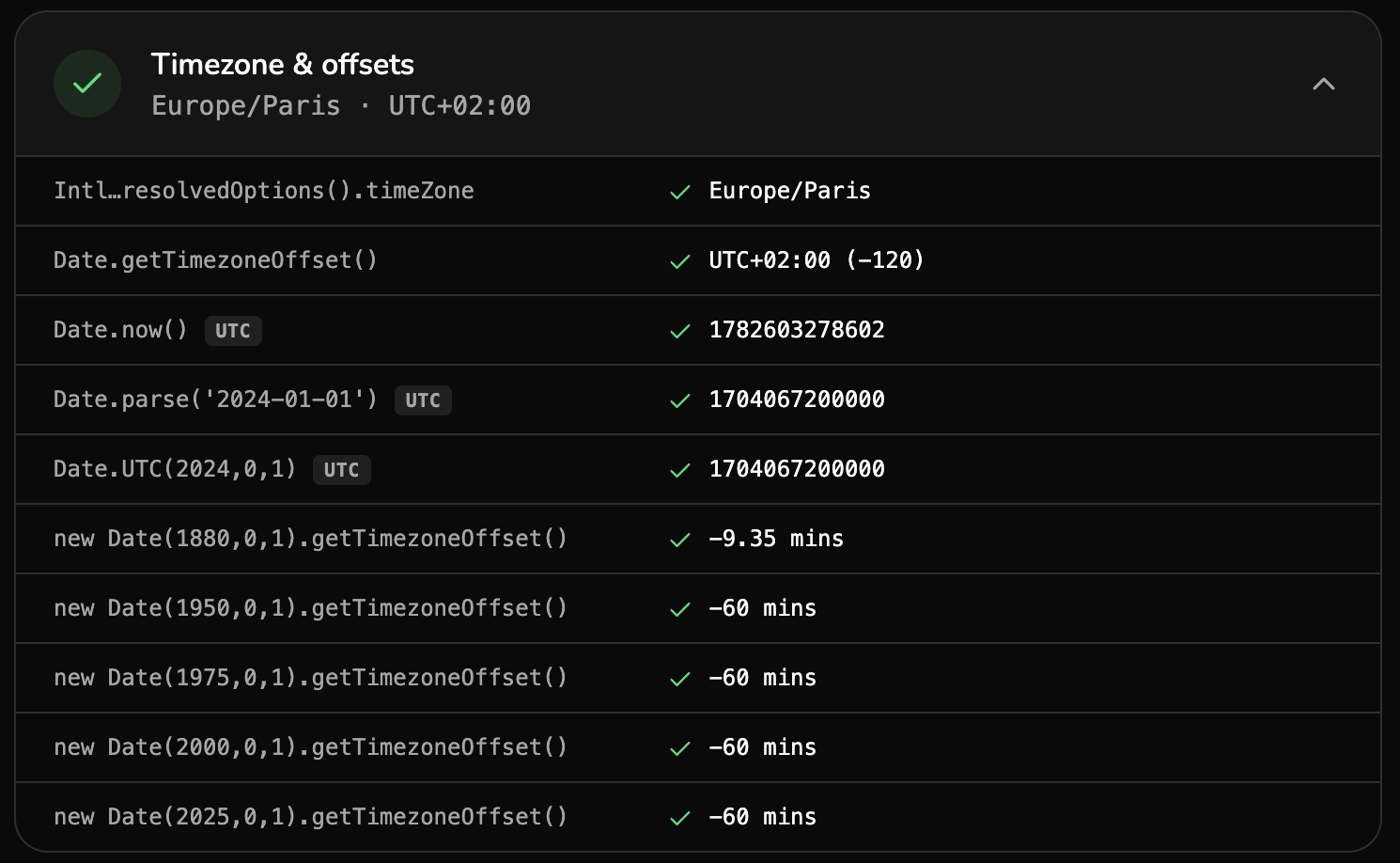
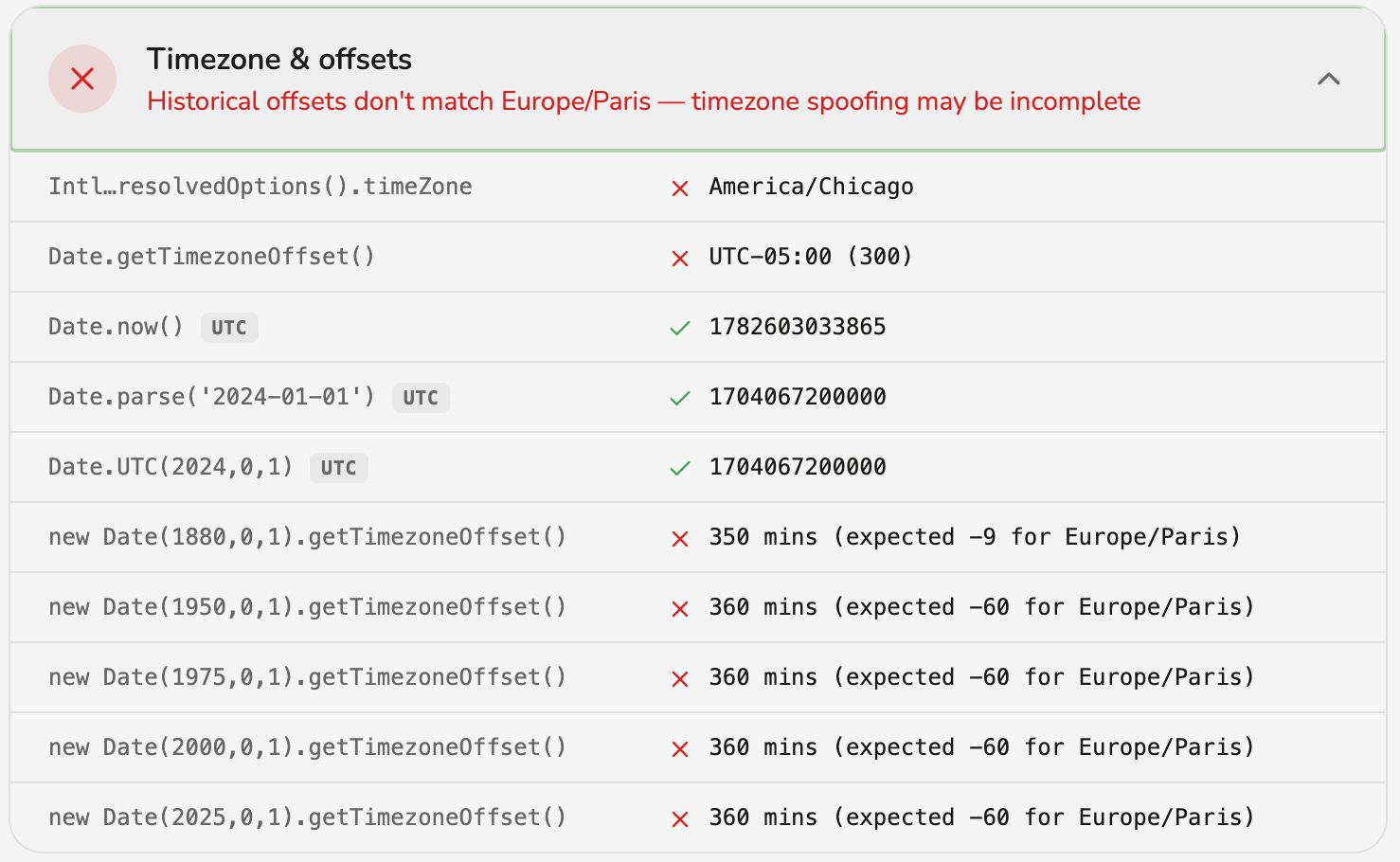 GeoSpoof matches the zone the pin sits in; Spoof Geolocation reports your real timezone instead.
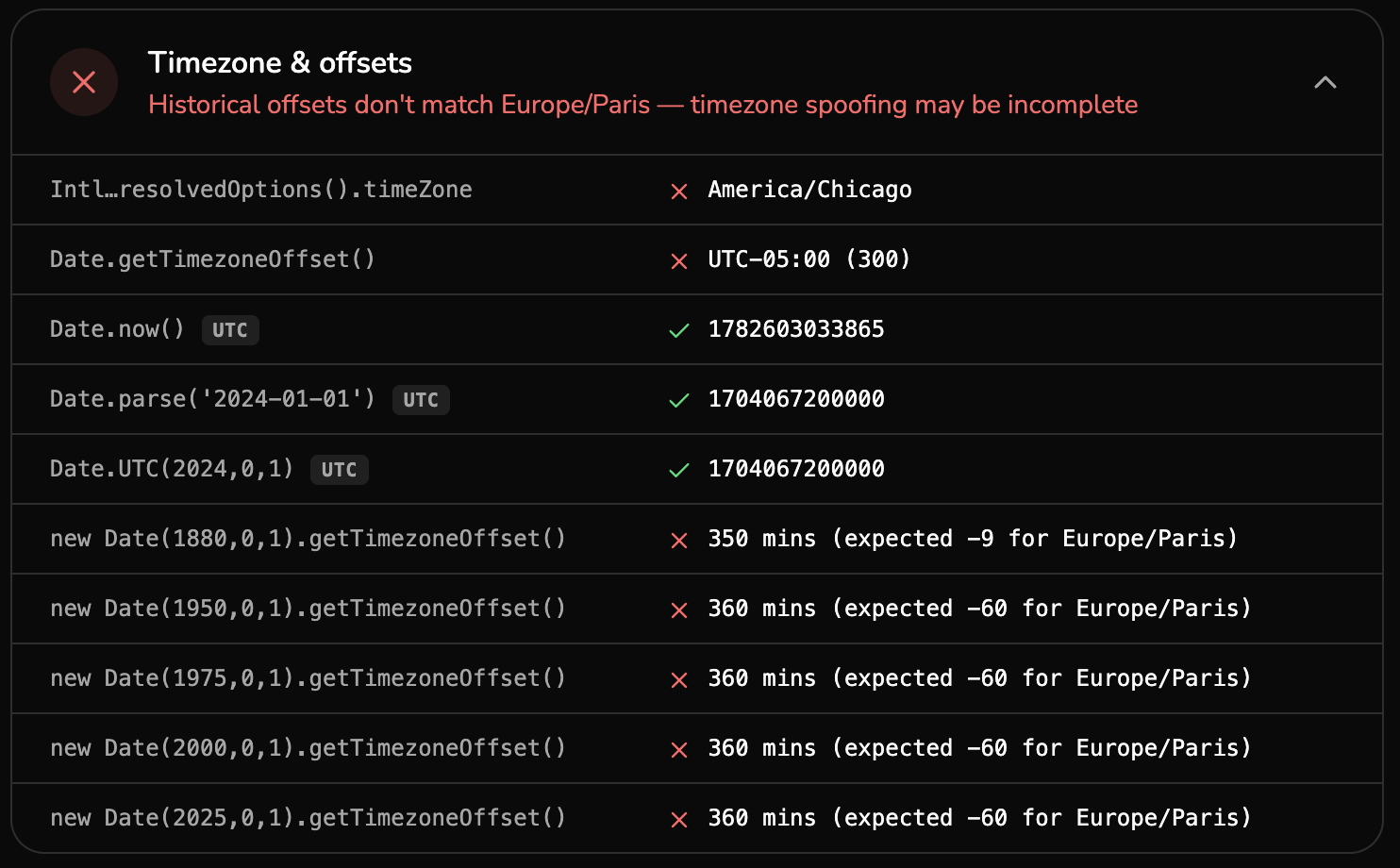
This is where Spoof Geolocation comes apart. It doesn't touch the timezone at
all, so getTimezoneOffset returns your real offset — not the spoofed
location's. The map says one place and the clock says wherever you actually are.
That's not just an inconsistency a site can flag; it's your real region leaking
straight through the spoof. GeoSpoof computes the offset from the target zone's
full history, so it stays consistent no matter where the pin is or which date a
script picks.
5. Date components
Scripts can read the clock through individual Date methods like getHours(),
getDate(), and getDay(). Each one has to reflect the spoofed timezone, not
the machine the browser is actually running on.
 Spoof Geolocation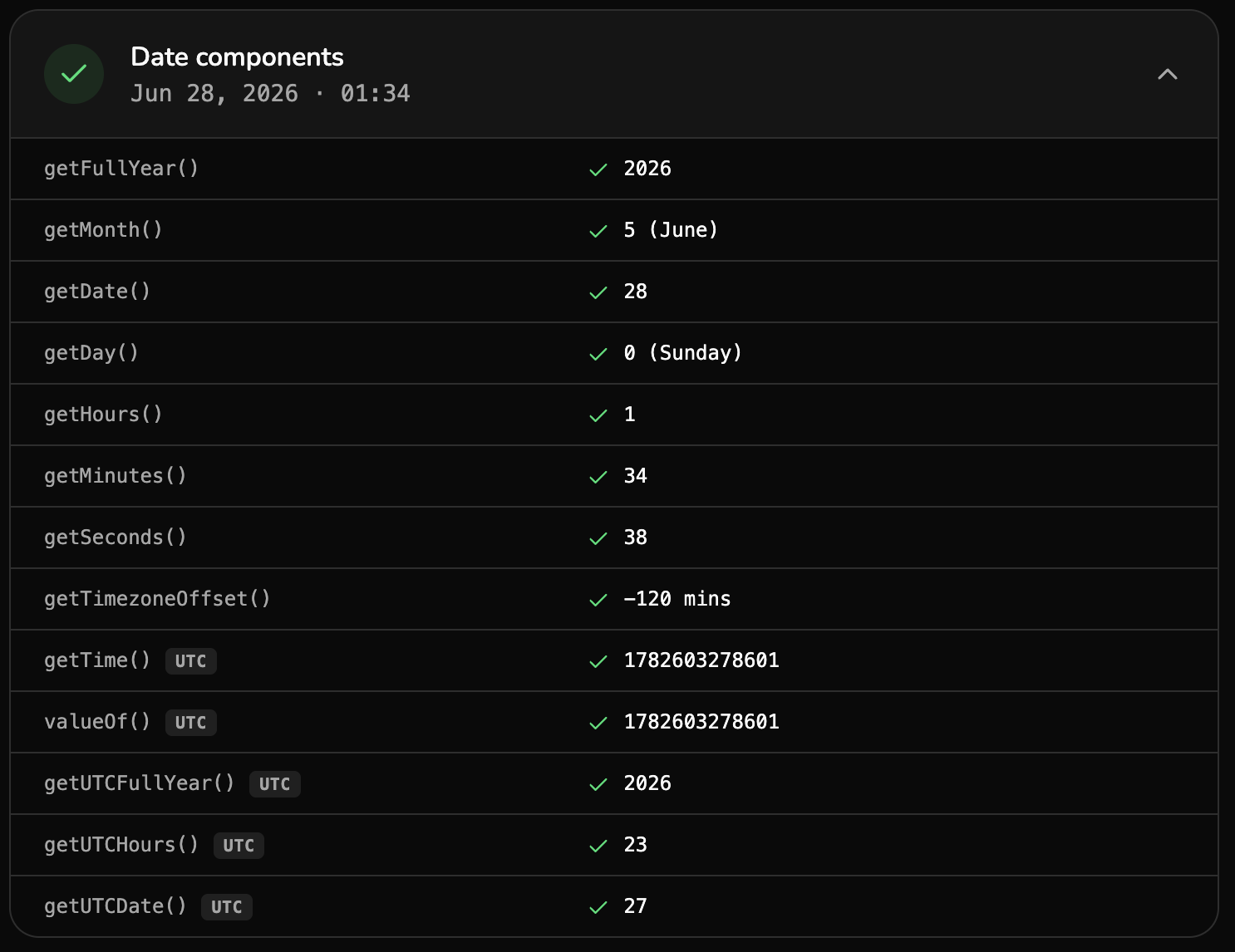
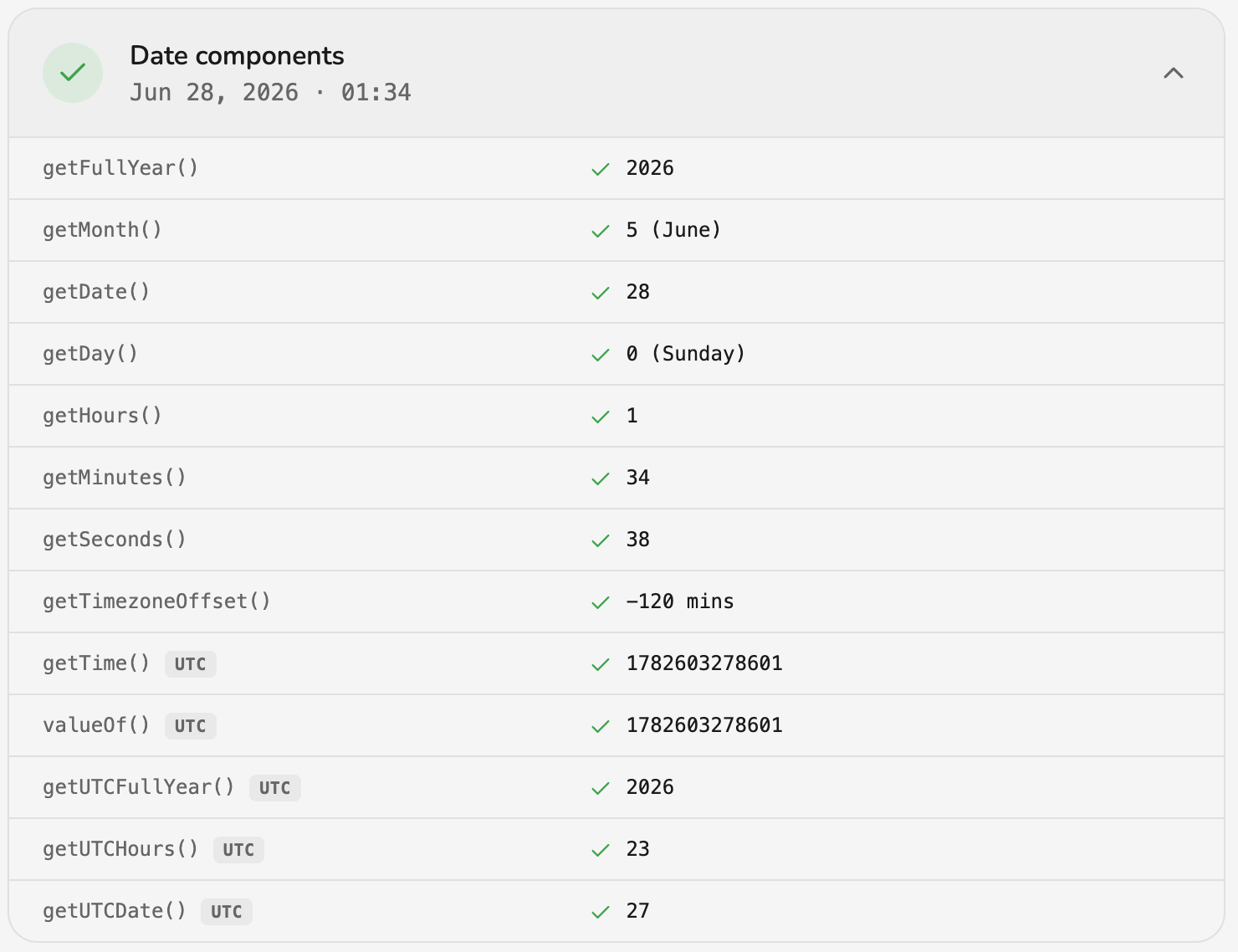
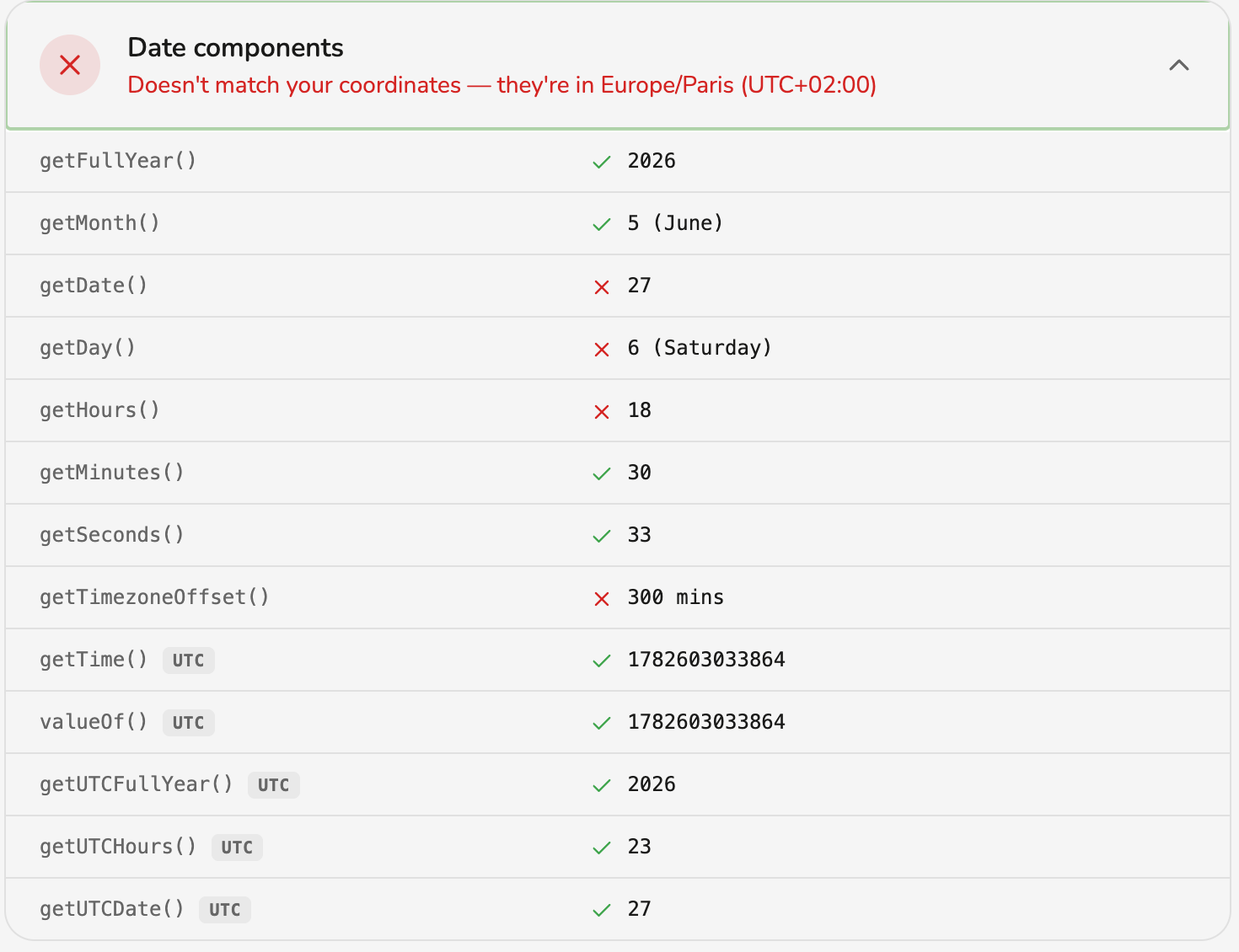 GeoSpoof returns the spoofed location's local time; Spoof Geolocation returns your real local time.
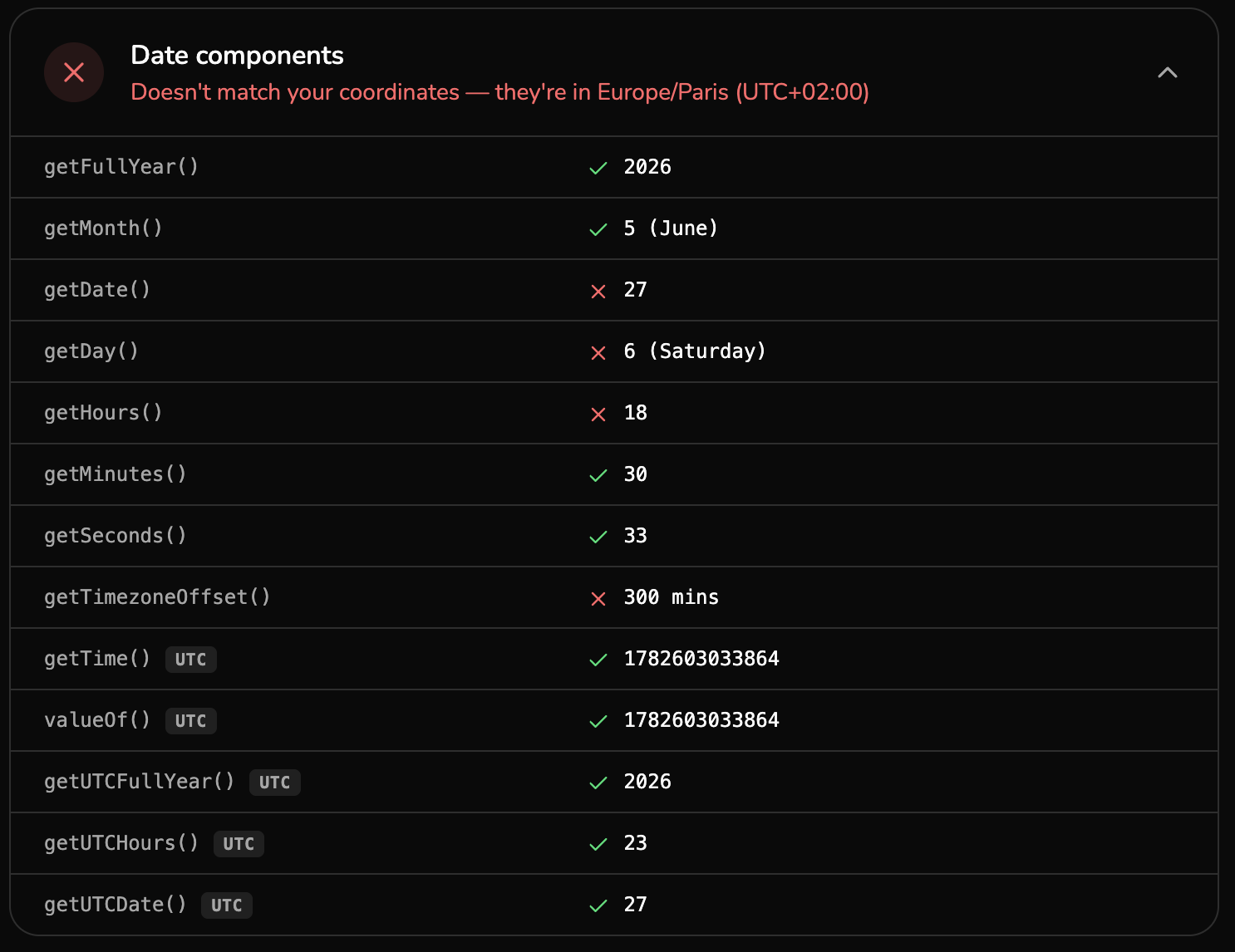
Spoof Geolocation gets getDate, getDay, getHours, and getTimezoneOffset
wrong. Because it never changes your timezone, these come back in your real
local time rather than the spoofed location's — and when the gap between the two
crosses midnight, even the day of the week and the calendar date are wrong. The
getUTC* counterparts (getUTCHours, getUTCDate, and friends) do read
correctly, but only because UTC is the same no matter where you spoof to — they
say nothing about the location on the map. GeoSpoof returns the correct values
across all of them.
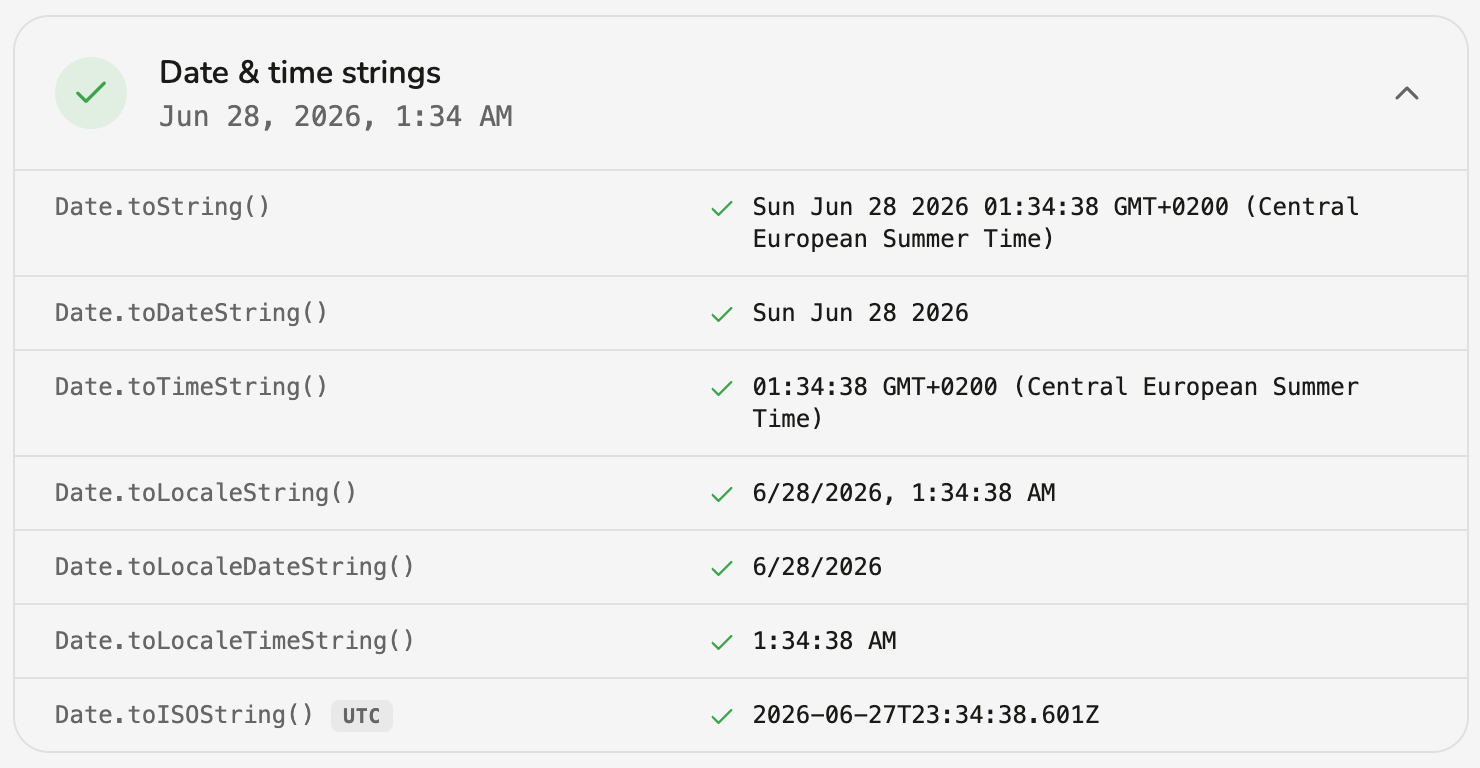
6. Date and time strings
The Date object also stringifies itself, and those strings embed the timezone
name and offset in plain text. toString(), toTimeString(), and
toLocaleTimeString() all have to agree with everything above.
 Spoof Geolocation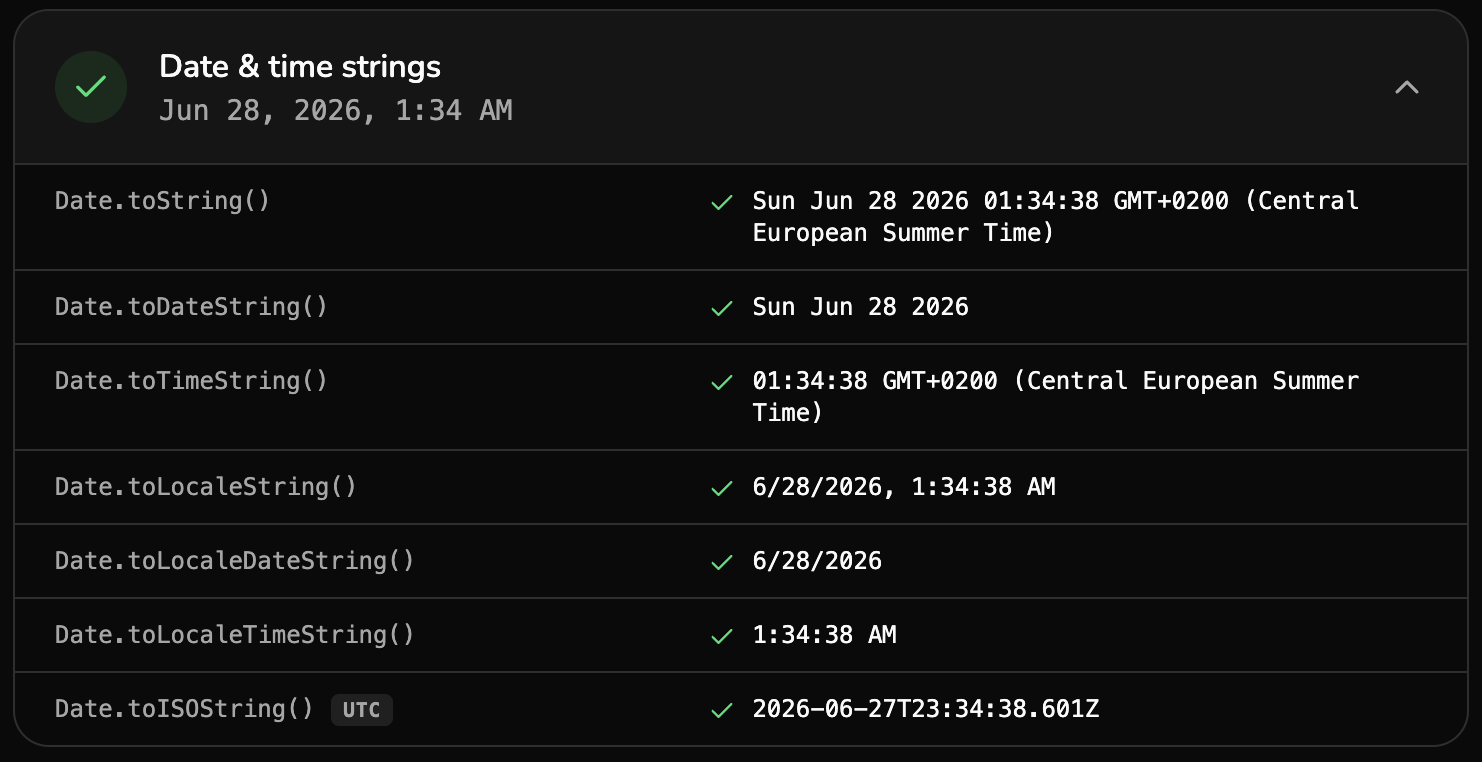
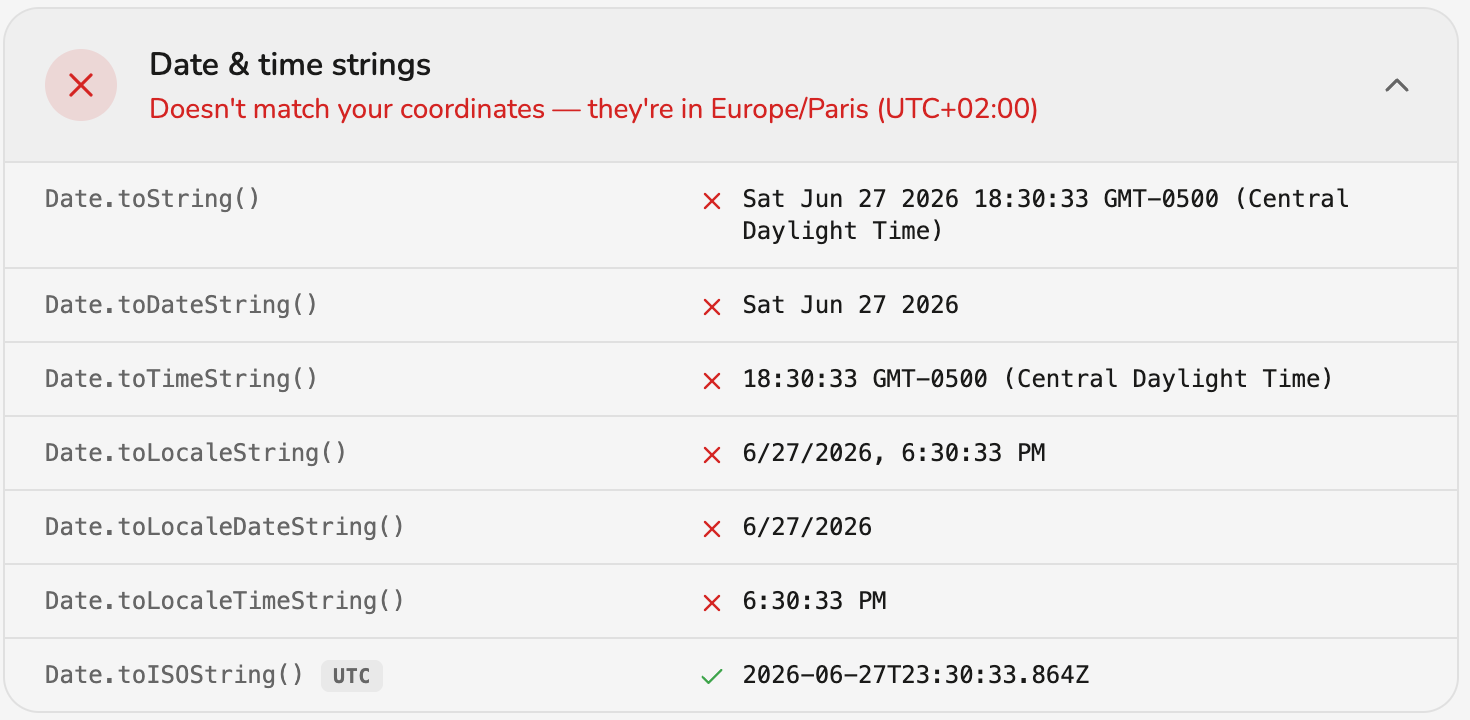 GeoSpoof's Date strings match the spoofed zone; Spoof Geolocation only gets the absolute UTC string right.
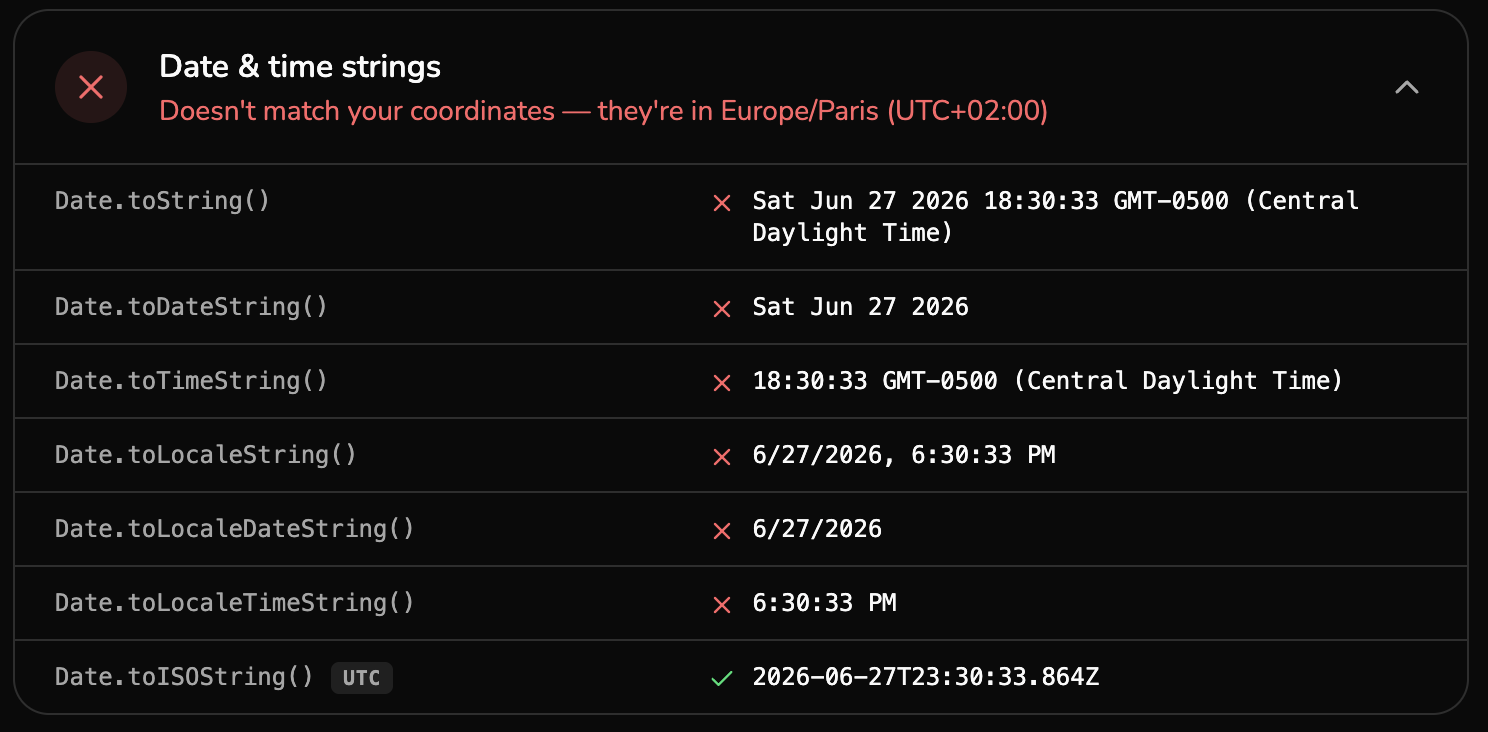
Every date and time string comes back wrong for Spoof Geolocation except the
absolute UTC one (toUTCString / toISOString) — and that one only matches
because it's the same for everyone regardless of timezone, so it proves nothing.
Every zone-aware string (toString, toTimeString, toLocaleTimeString) still
carries your real timezone. A script doesn't even have to call a special API for
this; it just formats a date and reads the offset out of the text. GeoSpoof gets
all of them right.
7. Intl formatting
The Intl API is another way to read the locale and timezone, and it's how most
modern apps format dates and numbers.
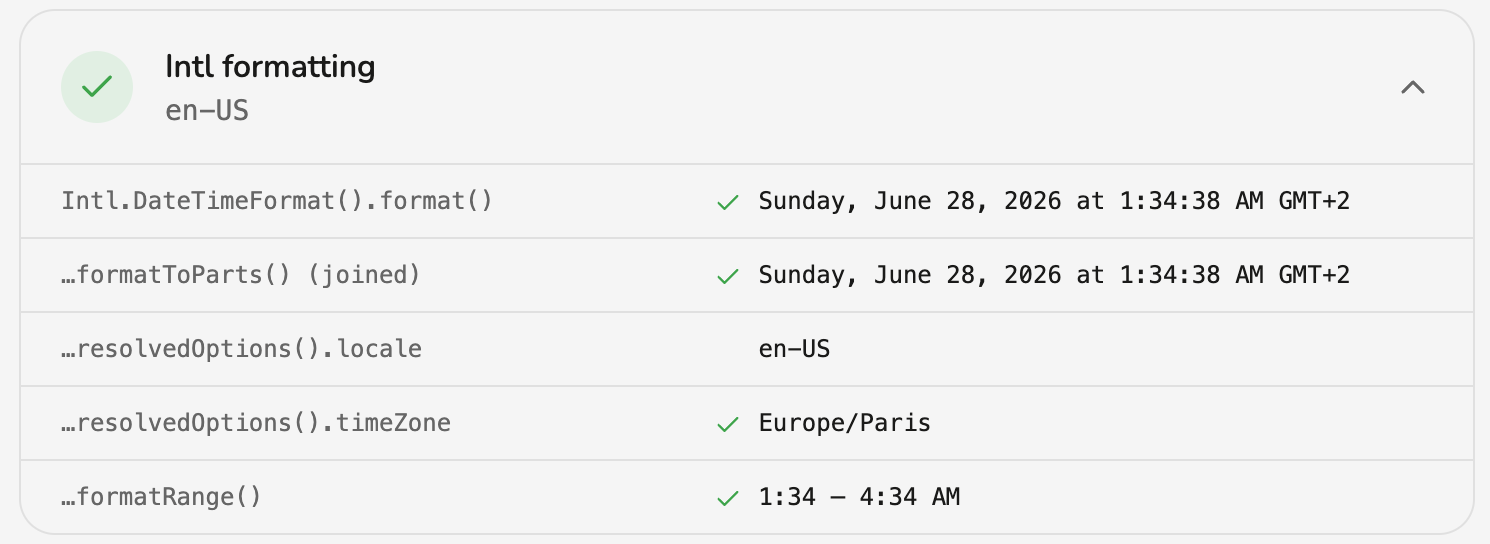 Spoof Geolocation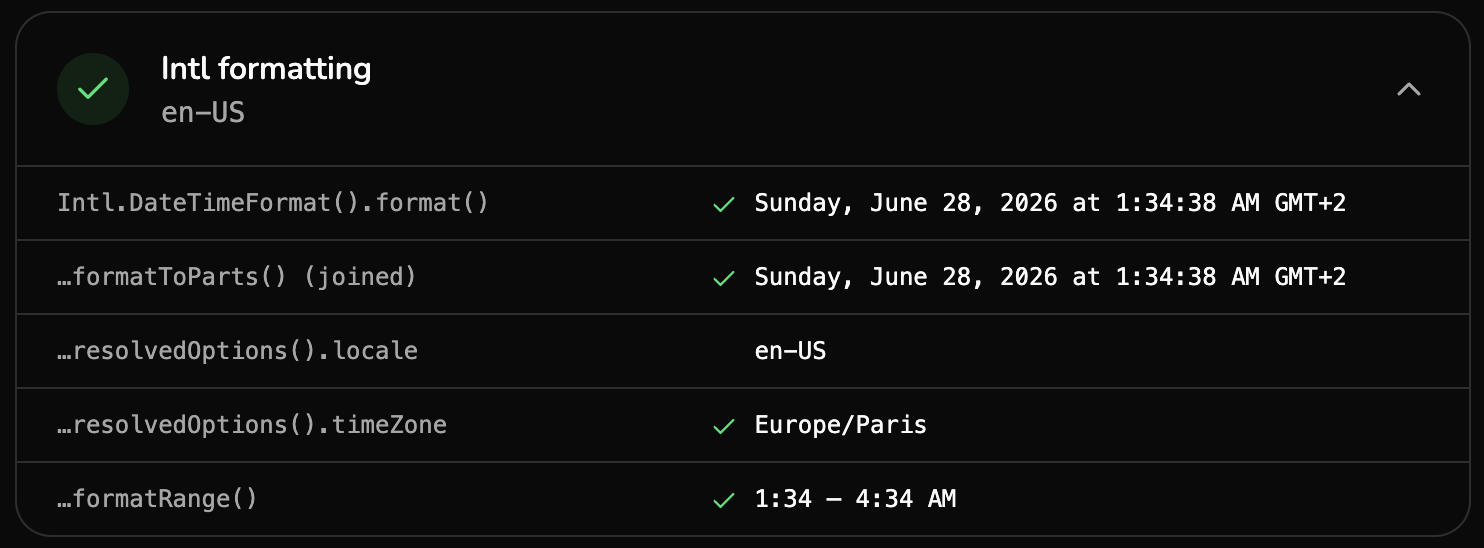
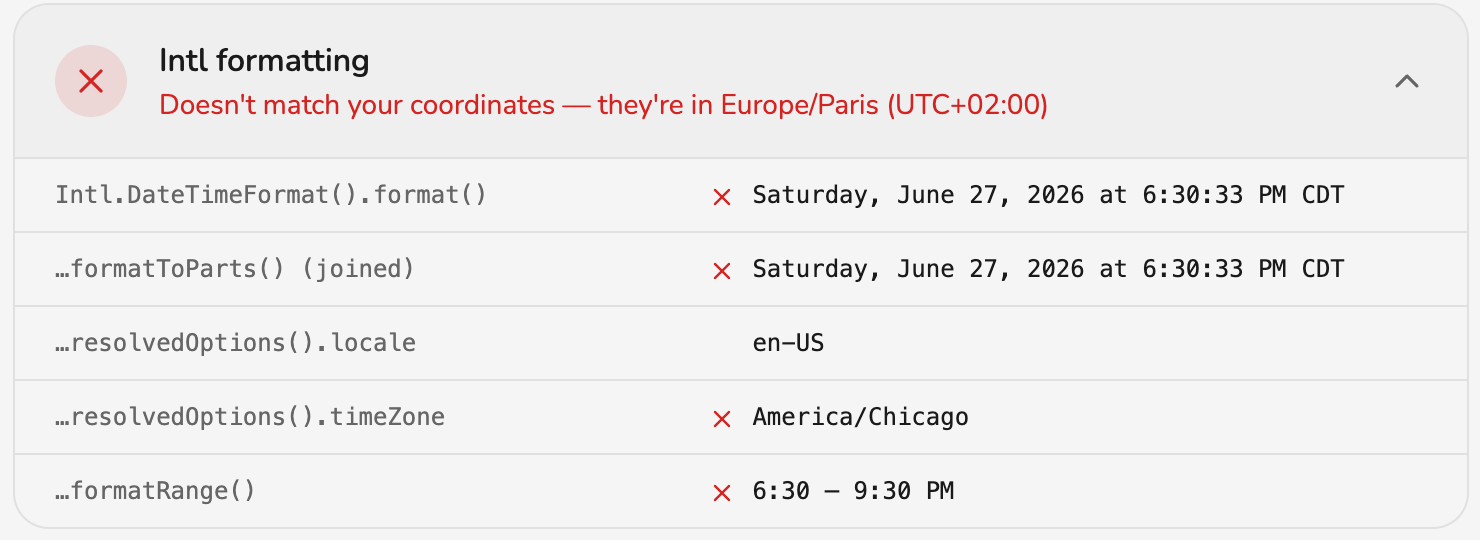 GeoSpoof reports the spoofed zone through Intl; Spoof Geolocation reports your real one.
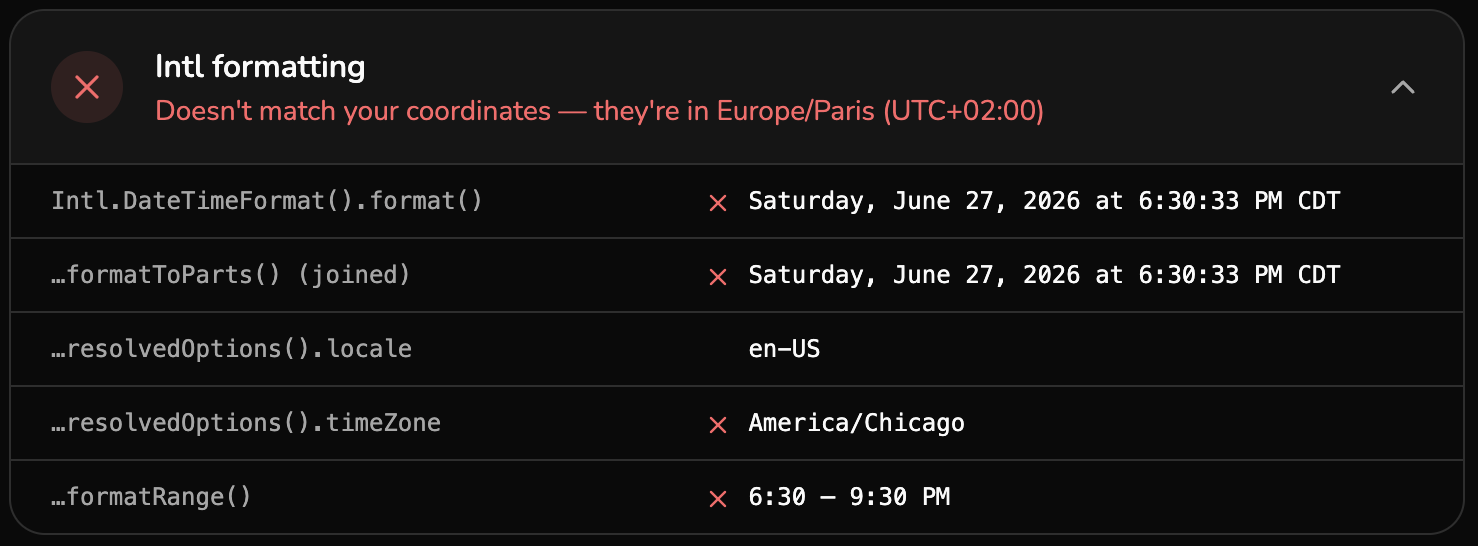
Spoof Geolocation fails all of the Intl formatting checks. Intl.DateTimeFormat
resolves to your real timezone instead of the spoofed zone, so anything an app
renders through it quietly carries your actual location. GeoSpoof returns correct
Intl formatting that matches the pin.
8. Advanced surfaces
The last check is the exotic stuff: code running in contexts that aren't the main page. Blob URLs, data URLs, and nested workers each get their own JavaScript environment, and a spoof that only patches the top-level window leaves these wide open.
GeoSpoof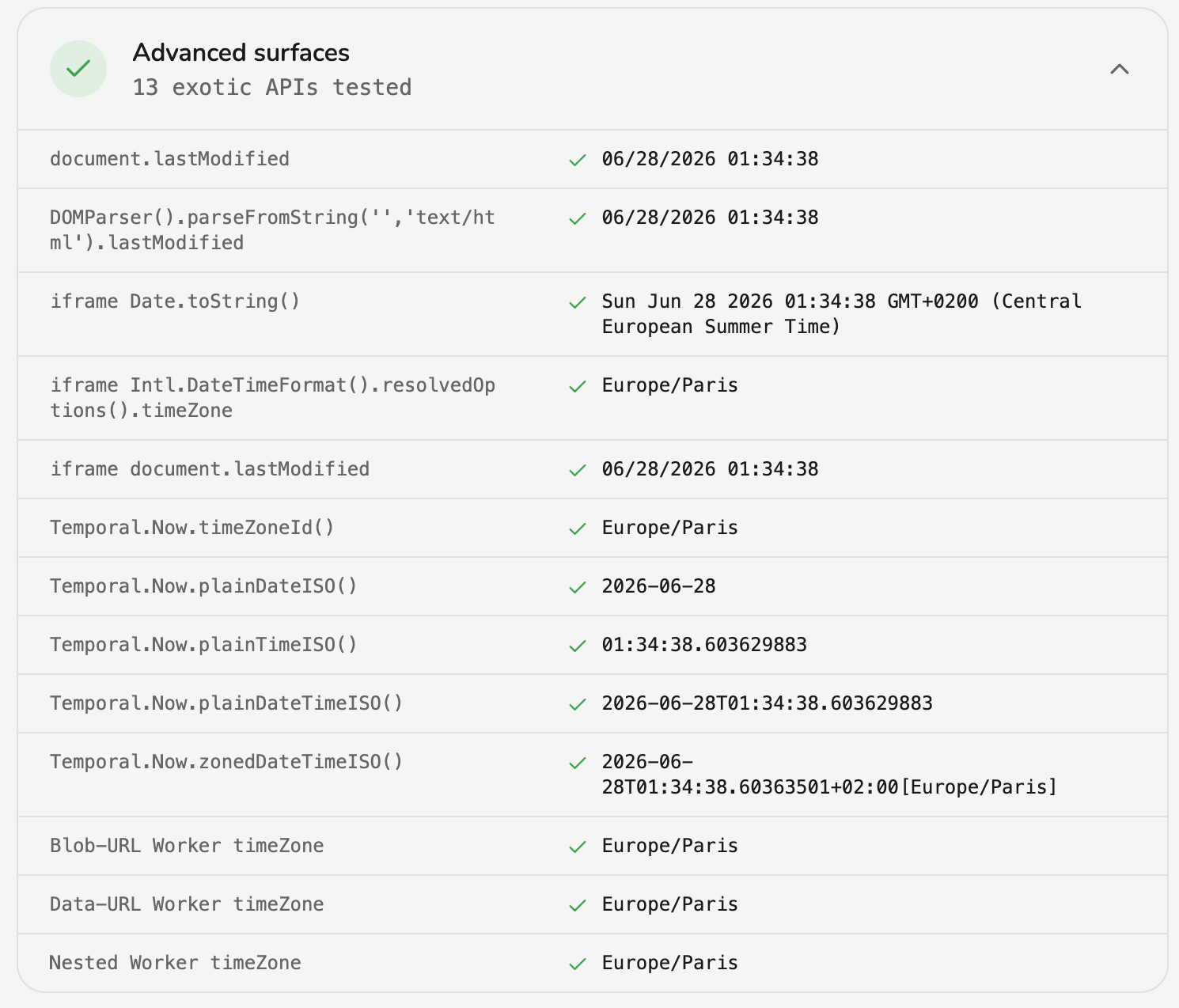 Spoof Geolocation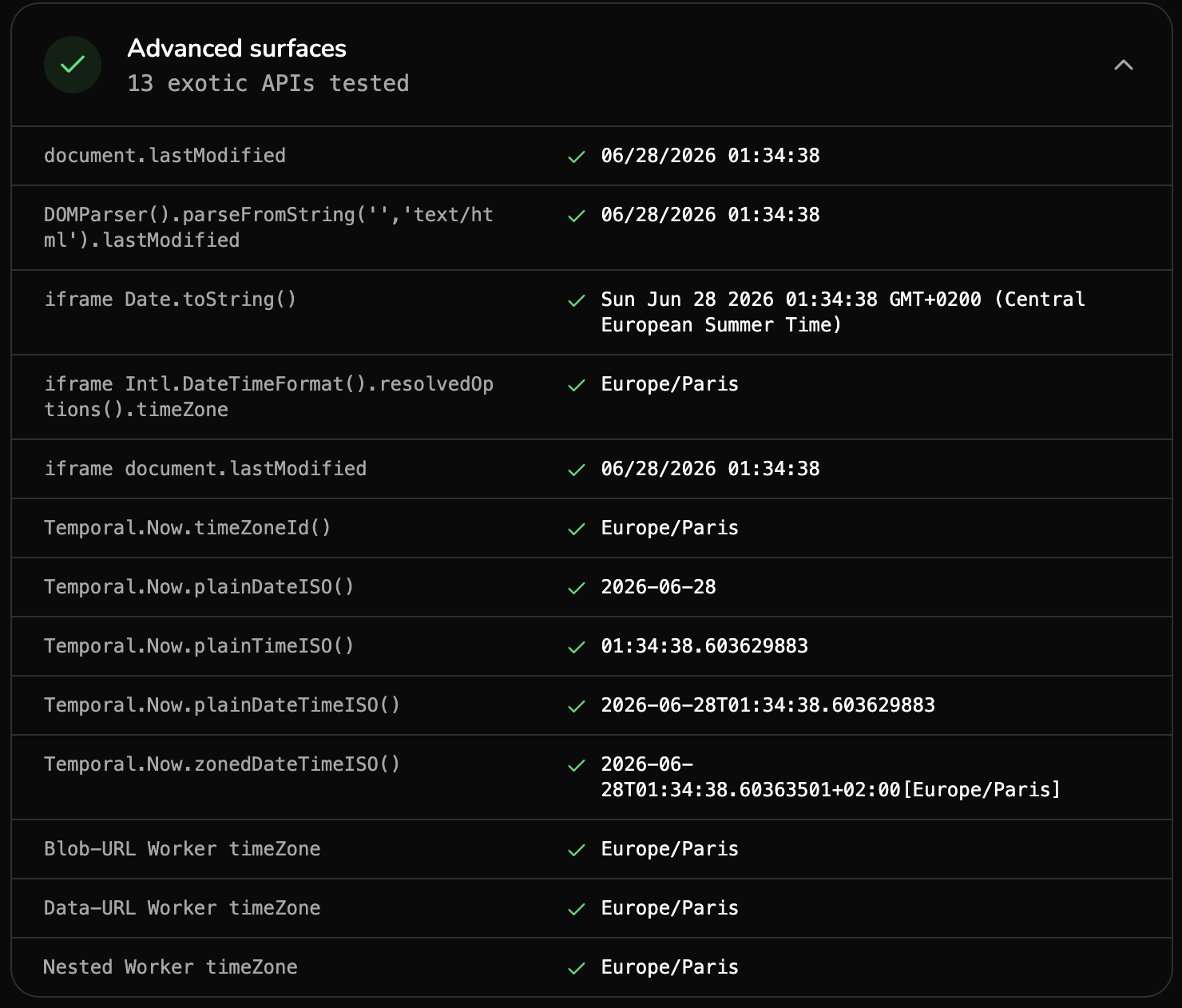
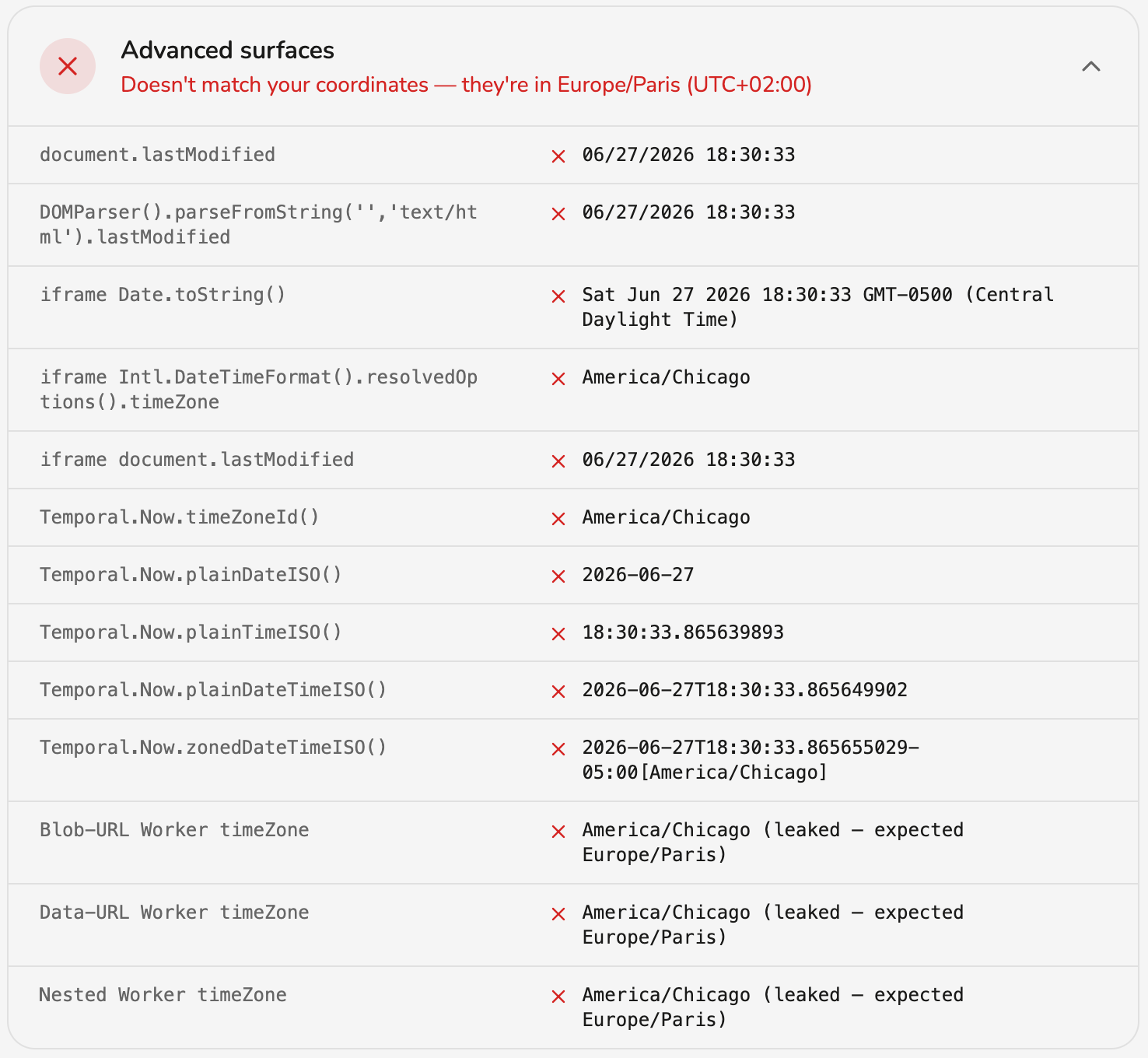 GeoSpoof covers blob-URL, data-URL, and nested workers; Spoof Geolocation leaks through all of them.
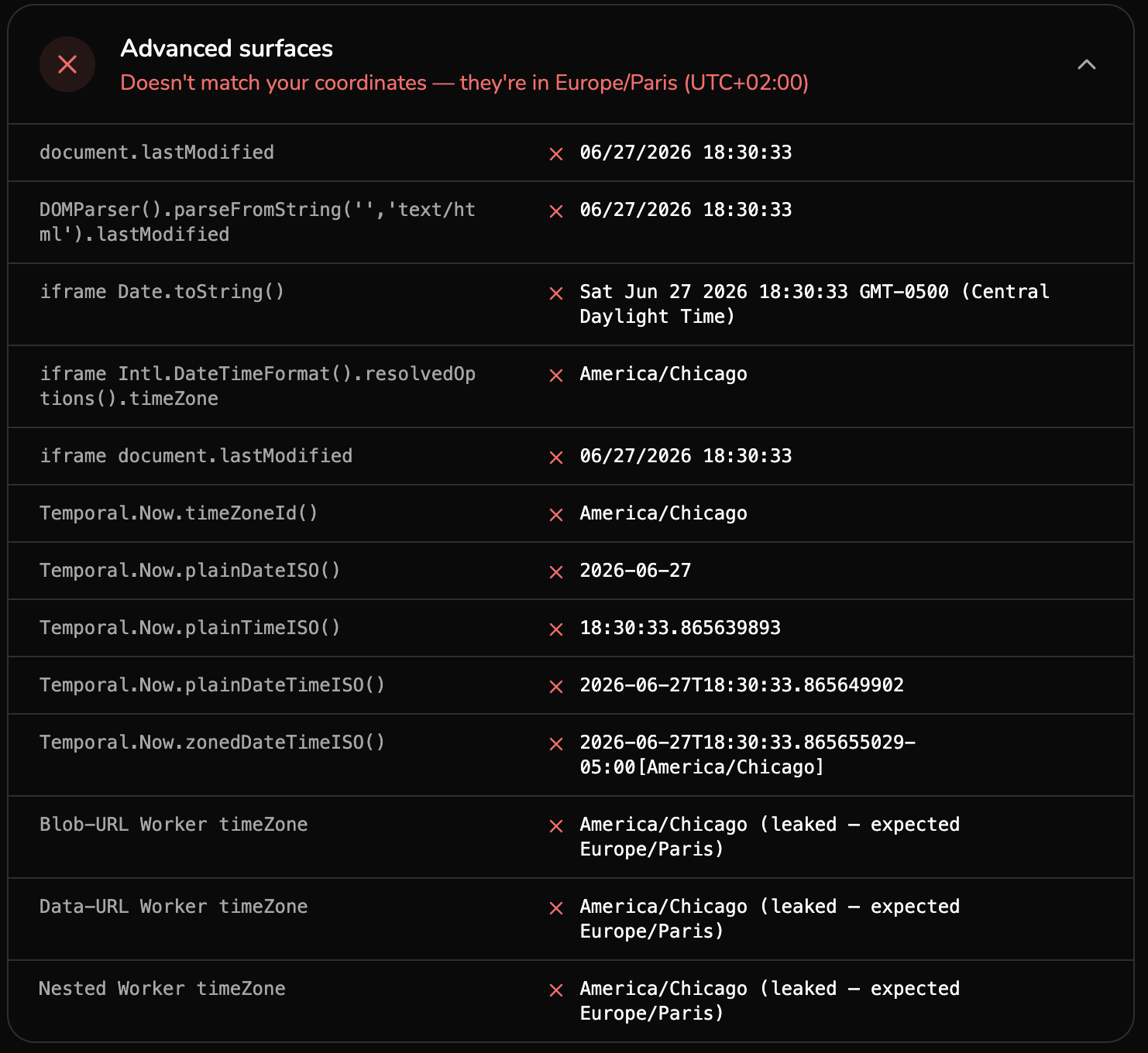
Spoof Geolocation fails every advanced surface — spin up a worker through a blob URL, a data URL, or a nested worker and it reports the real environment, undoing the spoof from inside. These are the hardest surfaces to cover, and they're where a lot of extensions stop. GeoSpoof handles all three.
The scorecard
| Signal | GeoSpoof | Spoof Geolocation |
|---|---|---|
| Geolocation (the map pin) | Pass | Pass |
| Timezone & offsets | Correct for the spoofed zone | Reports your real timezone |
Date components (getDate/getDay/getHours/getTimezoneOffset) | Correct | Your real local time |
| Date & time strings | Correct | Only the absolute UTC string matches |
| Intl formatting | Pass | Reports your real zone |
| Advanced surfaces (blob/data/workers) | Covered | Leaks the real environment |
Why this matters
Spoof Geolocation's failures all trace back to one root cause: it moves the
coordinates but never changes your timezone, so every time-based signal — the
offset, the Date methods, the string methods, and Intl — keeps reporting the
machine you're really on. That's worse than a simple mismatch. It's not just that
the clock disagrees with the map; it's that the clock is actively broadcasting
your real region. A site doesn't only learn that you're spoofing
(the contradiction it cross-checks for),
it gets a strong hint about where you actually are.
That's the difference the test surfaces: Spoof Geolocation changes the location on the map but leaves the rest of the browser telling the truth about you. GeoSpoof's whole design goal is that every signal follows the pin, so a site checking any of them sees one coherent location instead of a seam. If you're shopping for a Spoof Geolocation alternative, that consistency — not the length of a feature list — is what separates the best location spoofing extension from one that just moves the map pin.
We ran the same test against another popular extension in our Geoceptor vs GeoSpoof comparison. It failed a different mix of signals — including a WebRTC leak that exposed the real IP — but the takeaway was the same: moving the map pin is the easy part, and the signals around it are where a spoof gets caught.
Try it yourself
Don't take our screenshots for it. Install GeoSpoof, point it at a location outside your own timezone, and run the browser location test. The page checks the same signals against whatever you have active and shows you exactly which ones hold up.
GeoSpoof is free on Firefox, Chrome (and Brave/Edge), and the App Store for iPhone, iPad, and Mac:
FirefoxDesktop & AndroidAdd to Firefox →ChromeChrome, Brave & EdgeAdd to Chrome →iPhone, iPad & MacSafari via the App StoreGet on the App Store →We tested Spoof Geolocation as it behaved on the date of this post; extensions change, and a later version may close some of these gaps. The test page is public, so you can always re-run the comparison yourself and see the current state.
Frequently asked questions
- Is GeoSpoof a good Spoof Geolocation alternative?
- Yes. In our signal-by-signal test both extensions moved the map pin, but GeoSpoof also kept the timezone offsets, the Date methods, Intl formatting, and worker surfaces consistent with the spoofed location. Spoof Geolocation left your real timezone in place, so every time-based signal still pointed at your actual region. If you want an alternative that holds up to a full fingerprint check rather than just moving the pin, GeoSpoof is the stronger option.
- Does Spoof Geolocation change your timezone?
- No. In our test it set the geolocation coordinates but left your real timezone untouched, so the timezone offset, the Date methods, the Date strings, and Intl formatting all still reported your real zone instead of the location you set. The only value that matched was the absolute UTC time (toISOString and toUTCString), which is identical for everyone regardless of timezone — so it tells a site nothing and proves nothing.
- What is the best location spoofing extension?
- The best location spoofing extension keeps every fingerprinting signal consistent, not just the geolocation API. On our test GeoSpoof passed all of them; Spoof Geolocation moved the pin but left your real timezone in place, leaking your true region through the Date methods, Intl formatting, and worker contexts — and a single mismatch is enough to flag a spoof.
- Can a website tell that you are spoofing your location?
- Yes, if any signal disagrees. Sites cross-check the geolocation API against the timezone offset, individual Date methods, Intl formatting, and code running in workers; one contradiction reveals the spoof. A map pin in Tokyo paired with your real New York timezone is a contradiction — and worse, it hands the site your actual region — which is why moving only the coordinates is not enough.
- Why do timezone offsets matter when spoofing your location?
- Websites read your timezone and UTC offset straight from JavaScript. If they point at a different region than your spoofed geolocation, that contradiction flags you. An extension that leaves your real timezone in place while the map says Paris has already given itself away — and revealed roughly where you really are — no matter how accurate the coordinates are.
- What browsers does GeoSpoof support?
- GeoSpoof is free on Firefox (desktop and Android), Chrome and other Chromium browsers like Brave and Edge, and on the App Store for Safari on iPhone, iPad, and Mac. So whichever browser you were running Spoof Geolocation in, there's a GeoSpoof build for it.